LoRA: Low-Rank Adaptation of Large Language Models
Paper: LoRA: Low-Rank Adaptation of Large Language Models
Problem
Full fine-tuning updates all parameters of a large model for each downstream task. That is expensive in compute and memory, and it is hard to store many fine‑tuned copies in production.
Key idea
Freeze the pretrained weights and learn a low‑rank update to each selected weight matrix:
\[ W = W_0 + \Delta W, \qquad \Delta W = BA \]
If \(W_0\in\mathbb{R}^{d\times k}\), then \(B\in\mathbb{R}^{d\times r}\) and \(A\in\mathbb{R}^{r\times k}\) with \(r\ll\min(d,k)\). This replaces \(dk\) trainable parameters with \(r(d+k)\).
Where LoRA plugs in
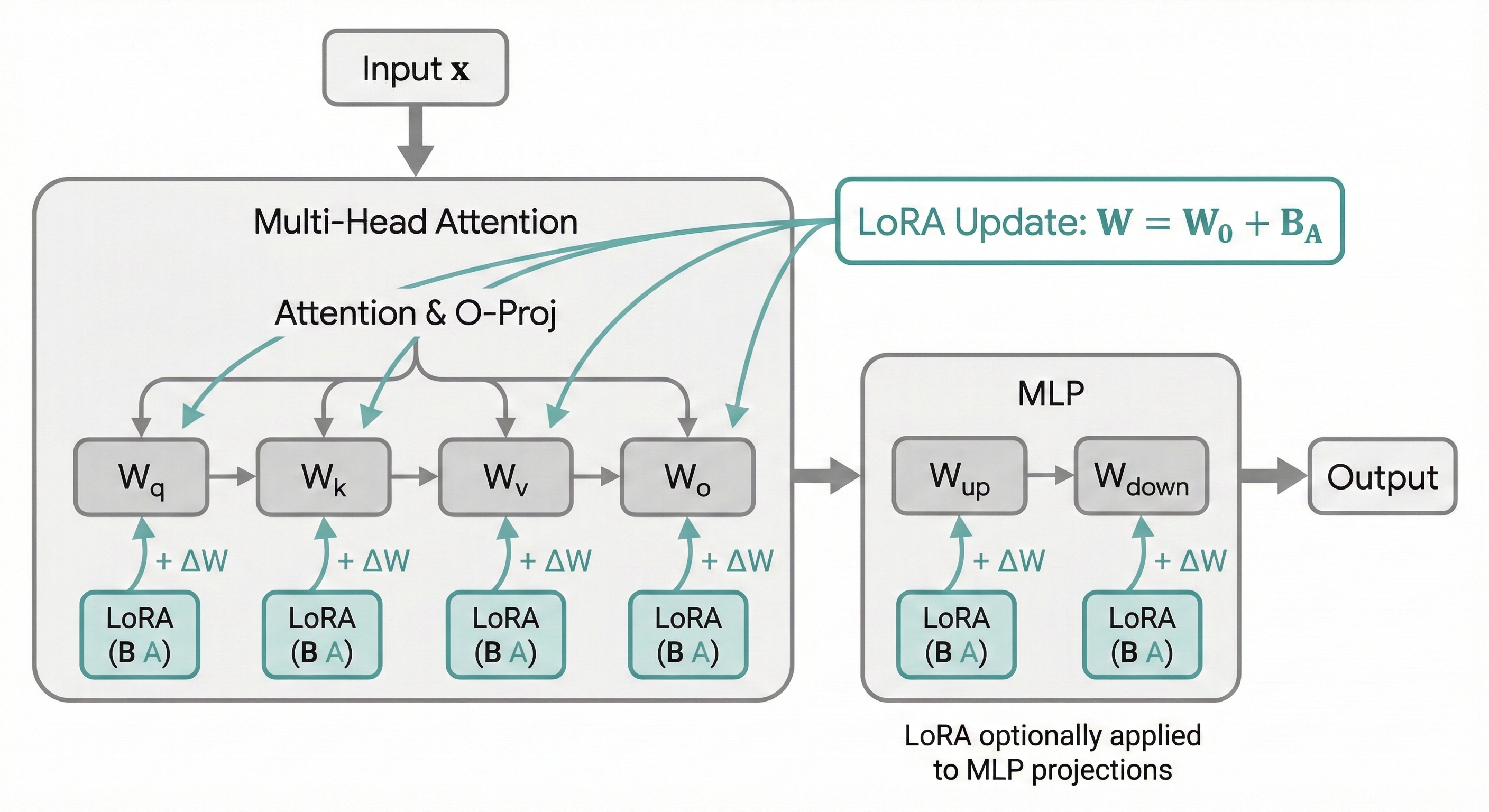
LoRA is typically applied to attention projections (e.g., \(W_q, W_k, W_v, W_o\)) and sometimes to MLP layers. You choose which matrices get low‑rank updates and the rank \(r\).
A compact block view
Below is a small matrix block for one attention projection (same idea for \(W_q, W_k, W_v, W_o\)):
\[ \begin{aligned} \text{proj: } & y = (W_0 + \Delta W)x \\ & \Delta W = BA,\quad B\in\mathbb{R}^{d\times r},\; A\in\mathbb{R}^{r\times k} \end{aligned} \]
You can apply this to Q/K/V/O, and optionally to MLP layers (e.g., the up/down projections).
Intuition: why low rank is enough
Many task‑specific updates live in a low‑dimensional subspace. LoRA assumes the weight update has low intrinsic rank, so a small \(r\) can capture most of the task‑specific change.
Initialization and scaling
- Init: \(A=0\), \(B\) random Gaussian → start from \(\Delta W=0\) so the model begins exactly at \(W_0\).
- Scaling: use \(\alpha/r\) to control update magnitude (similar in spirit to tuning learning rate).
In forward pass (conceptually):
# x: [batch, k]
# A: [r, k], B: [d, r]
scale = alpha / r
lora_out = (x @ A.T @ B.T) * scale
Inference cost
At inference, merge \(W_0\) and \(\Delta W\):
\[ W = W_0 + BA \]
This removes extra latency—the model runs as usual with the merged weight.
Benefits
- Large parameter savings: train only \(r(d+k)\) parameters per adapted matrix.
- Easy multi‑task deployment: store a small LoRA adapter per task.
- Minimal inference overhead after merging.
Comparison (high‑level)
- Adapters: insert new layers → extra depth and potential latency.
- Prefix/Prompt tuning: modify inputs; can work well but may be less expressive than weight updates.
- BitFit: tune only bias terms; extremely cheap but less flexible.
Limitations
- If \(r\) is too small, LoRA may underfit the task.
- Large domain shifts may need higher rank or full tuning.
- You must choose where to apply LoRA and what rank to use.
Takeaway. LoRA keeps the base model frozen and learns a compact low‑rank update, giving strong performance with far fewer trainable parameters and lightweight deployment across many tasks.