Theory-to-Repro: Linear Regression via Three Solvers
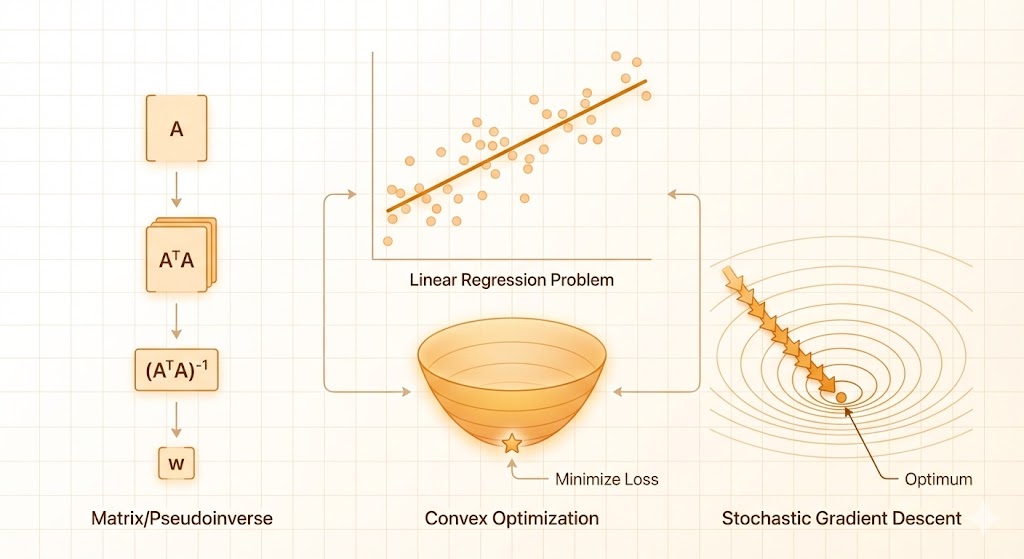
Linear regression is a single idea with multiple solution paths. In this note I solve the same least-squares objective three ways:
- Pseudo-inverse (closed form)
- Convex optimization (solver)
- Stochastic gradient descent (iterative)
All three target \[ \min_w \; \|Xw - y\|_2^2. \]
Problem setup
From the notebook, I used the Iris dataset and treated the class labels as numeric targets. Predictions are rounded to the nearest class. This is not a proper multi-class classifier, but it keeps the comparison focused on least squares.
from sklearn.datasets import load_iris
from sklearn.model_selection import train_test_split
import numpy as np

iris = load_iris()
X = iris['data']
y = iris['target']

# add bias column
X = np.hstack([np.ones((X.shape[0], 1)), X])
X_train, X_test, y_train, y_test = train_test_split(X, y, test_size=0.2)
Method 1: Pseudo-inverse (closed form)
The least-squares solution is \[ \hat{w} = X^+ y, \] where \(X^+\) is the Moore–Penrose pseudo-inverse (often computed via SVD). If \(X\) has full column rank, this matches \((X^T X)^{-1}X^T y\).
w = np.linalg.pinv(X_train) @ y_train
pred = X_test @ wPros: exact (up to floating point), fastest for small/medium problems.
Cons: can be expensive or unstable for huge or ill-conditioned matrices.
Method 2: Convex optimization (CVXPY)
We solve the same quadratic objective using a convex solver:
import cvxpy as cp

w = cp.Variable(X_train.shape[1])
objective = cp.Minimize(cp.sum_squares(X_train @ w - y_train))
problem = cp.Problem(objective)
problem.solve()

w = w.value
pred = X_test @ wPros: clean formulation, easy to add constraints or regularizers.
Cons: general solvers can be slower than the closed form.
Method 3: Stochastic gradient descent (SGD)
For mean-squared error, \[ \mathcal{L}(w)=\frac{1}{n}\sum_i (x_i^T w - y_i)^2, \] with gradient \[ \nabla_w \mathcal{L} = \frac{2}{n} X^T (Xw - y). \]
Mini-batch SGD updates \[ w \leftarrow w - \eta \, \nabla_w \mathcal{L} \] using small batches.
W = np.random.normal(0, 1, size=X_train.shape[1])
eta = 1e-2
batch = 2

for _ in range(epochs):
    for i in range(X_train.shape[0] // batch):
        xb = X_train[i*batch:(i+1)*batch]
        yb = y_train[i*batch:(i+1)*batch]
        y_pred = xb @ W
        grad = (2 / batch) * xb.T @ (y_pred - yb)
W -= eta * gradPros: scales to large datasets, works online.
Cons: requires tuning (learning rate, batch size, epochs), converges approximately.
Comparison
| Method | Objective | Exact? | Scales well? | Easy to constrain? |
|---|---|---|---|---|
| Pseudo-inverse | \(\|Xw-y\|_2^2\) | Yes | Medium | No |
| Convex solver | \(\|Xw-y\|_2^2\) | Yes (to tol) | Medium | Yes |
| SGD | \(\|Xw-y\|_2^2\) | Approx | Yes | Yes (via regularization) |
Takeaways
- All three methods solve the same least-squares problem.
- Pseudo-inverse is the cleanest theoretical solution.
- Convex optimization is the easiest way to add constraints.
- SGD is the most scalable for large data.
Next step: replace rounded regression with proper multi-class logistic regression and compare accuracy + calibration.