Goodfellow Deep Learning — Chapter 10.9: Leaky Units and Multiple Time Scales
Deep Learning Book - Chapter 10.9 (page 398)
To address the long-term dependency problem, models can be designed to operate on multiple time scales, allowing some components to process information at fine temporal resolution, while others operate at coarser time scales to effectively propagate information from the distant past.
Leaky Unit
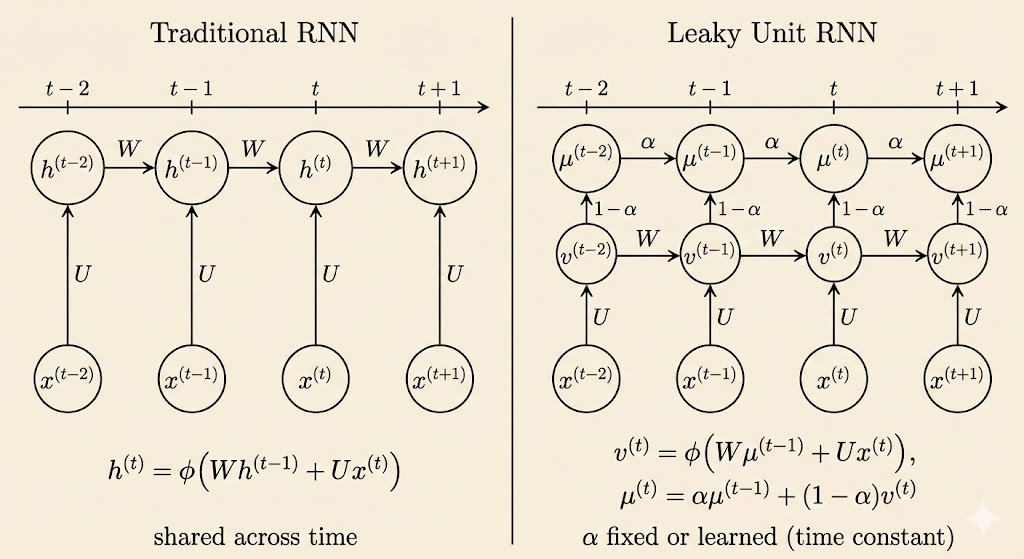
Leaky units introduce an explicit separation between instantaneous state computation and long-term state integration. By using a candidate state \(v^{(t)}\) and a time constant \(\alpha\), the model can operate on multiple time scales, alleviating long-term dependency issues without relying solely on recurrent weight dynamics.
\[ u^t \leftarrow \alpha u^{t-1}+(1-\alpha)v^t \]
In a leaky RNN, the candidate state \(v^{(t)}\) replaces the instantaneous hidden update, while the leaky state \(\mu^{(t)}\) replaces the true hidden state. The relation between them is temporal integration, not a learned transformation.
Temporal Skip Connection
Temporal skip connections address long-term dependencies by introducing direct pathways across multiple time steps, allowing information and gradients to propagate over longer temporal distances without relying solely on step-by-step recurrence.
Removing Connection
Removing connections addresses long-term dependencies by eliminating length-1 temporal connections, forcing information to propagate only through longer-range pathways and thereby biasing the model toward coarser time scales.