Lecture 1: The Column Space of A Contains All Vectors Ax
Overview
This lecture builds the geometric meaning of column space and rank:
- \(Ax\) is always a linear combination of the columns of \(A\)
- The column space \(C(A)\) contains every vector of the form \(Ax\)
- Rank counts independent columns (and independent rows)
- CR factorization separates basis columns from how they combine
- Row-by-column vs column-by-row views of matrix multiplication
Ax and the Column Space
Let \[ A = \begin{bmatrix} 2 & 1 & 3 \\ 3 & 1 & 4 \\ 5 & 7 & 12 \end{bmatrix}, \quad x = \begin{bmatrix} x_1 \\ x_2 \\ x_3 \end{bmatrix} \]
Then \[ Ax = x_1 \begin{bmatrix}2\\3\\5\end{bmatrix} + x_2 \begin{bmatrix}1\\1\\7\end{bmatrix} + x_3 \begin{bmatrix}3\\4\\12\end{bmatrix} \]
So every \(Ax\) is a linear combination of the columns of \(A\).
Key idea: The set of all vectors \(Ax\) equals the column space \(C(A)\).
Examples
Rank 1 matrix (column space is a line): \[ \begin{bmatrix} 1 & 3 & 8 \\ 1 & 3 & 8 \\ 1 & 3 & 8 \end{bmatrix} = \begin{bmatrix} 1 \\ 1 \\ 1 \end{bmatrix} \begin{bmatrix} 1 & 3 & 8 \end{bmatrix} = uv^T \]
Rank 2 matrix (column space is a plane): If \(c_1 + c_2 = c_3\), then the three columns lie in the same plane.
Independent Columns and Rank
The number of independent columns is the rank of \(A\).
Basis and CR Factorization
Using the same matrix: \[ A = \begin{bmatrix} 2 & 1 & 3 \\ 3 & 1 & 4 \\ 5 & 7 & 12 \end{bmatrix} = \begin{bmatrix} 2 & 1 \\ 3 & 1 \\ 5 & 7 \end{bmatrix} \begin{bmatrix} 1 & 0 & 1 \\ 0 & 1 & 1 \end{bmatrix} = CR \]
- Two independent columns in \(\mathbb{R}^3\) span the column space
- Two independent rows span the row space
- Column rank = row rank = matrix rank = 2
Shape check: \(A_{3 \times 3} = C_{3 \times 2} R_{2 \times 3}\).
Column Space of a Product
Is \(ABCDx\) in the column space of \(A\)? Yes.
\[ ABCDx = A(BCDx) \]
So it is always a linear combination of the columns of \(A\).
Matrix Multiplication: Rows vs Columns
Let \(A\) be \(m \times n\) and \(B\) be \(n \times p\).
Row by Column (Inner Product)
- Each entry is a dot product (row of \(A\) with column of \(B\))
- There are \(m\) rows and \(p\) columns, so \(m \cdot p\) dot products
- Each dot product uses \(n\) multiplications and additions
- Complexity: \(m \cdot p \cdot n\)
Column by Row (Outer Product)
The \(k\)-th column of \(A\) times the \(k\)-th row of \(B\) gives an \(m \times p\) matrix. Summing those outer products:
\[ AB = \sum_{k=1}^n (\text{col}_k(A))(\text{row}_k(B)) \]
Each outer product builds an \(m \times p\) matrix, and we do this for \(n\) columns: \(n \cdot m \cdot p\) total multiplications and additions.
Therefore, every column of \(AB\) lies in the column space of \(A\).
Exercises
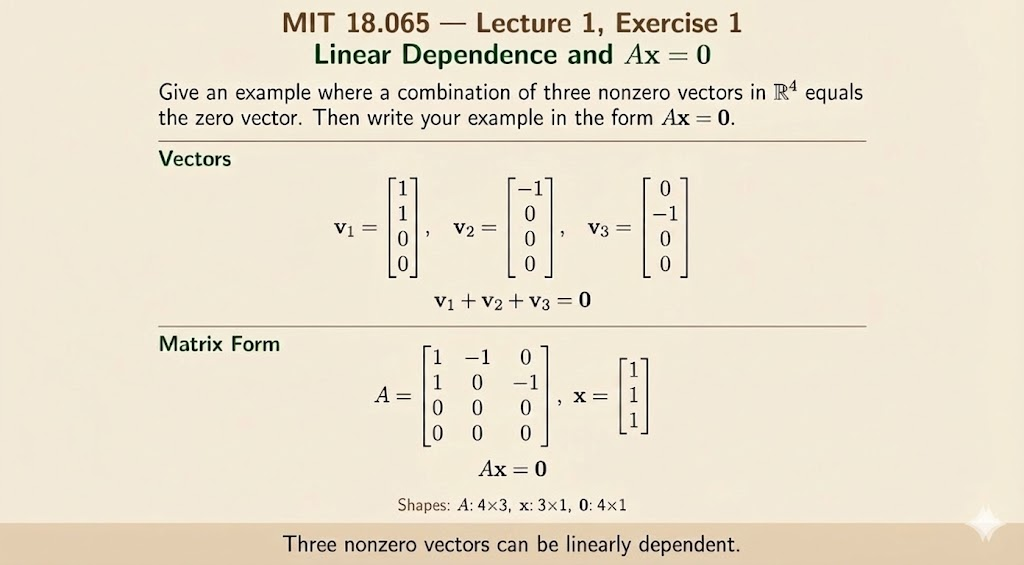
1. A Nontrivial Combination to Zero
Give three nonzero vectors in \(\mathbb{R}^4\) whose combination is zero, then write it as \(Ax = 0\).
\[ v_1=\begin{bmatrix}1\\1\\0\\0\end{bmatrix},\quad v_2=\begin{bmatrix}-1\\0\\0\\0\end{bmatrix},\quad v_3=\begin{bmatrix}0\\-1\\0\\0\end{bmatrix} \]
\[ 1 \cdot v_1 + 1 \cdot v_2 + 1 \cdot v_3 = \mathbb{0} \]
\[ A= \begin{bmatrix} 1 & -1 & 0 \\ 1 & 0 & -1 \\ 0 & 0 & 0 \\ 0 & 0 & 0 \end{bmatrix}, \quad x= \begin{bmatrix} 1\\1\\1 \end{bmatrix}, \quad Ax=0 \]
Shapes: \(A\) is \(4 \times 3\), \(x\) is \(3 \times 1\), \(0\) is \(4 \times 1\).
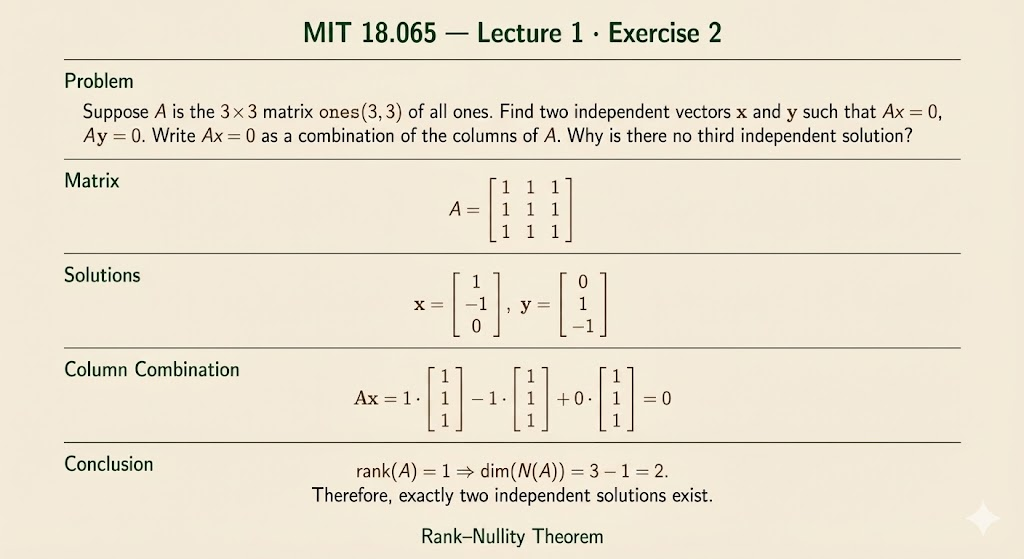
2. Null Space of the All-Ones Matrix
Let \[ A= \begin{bmatrix} 1 & 1 & 1 \\ 1 & 1 & 1 \\ 1 & 1 & 1 \end{bmatrix} \]
Find two independent vectors \(x\) and \(y\) that solve \(Ax=0\) and \(Ay=0\).
\[ x=\begin{bmatrix}1\\-1\\0\end{bmatrix},\quad y=\begin{bmatrix}0\\1\\-1\end{bmatrix} \]
Column combination for \(Ax=0\): \[ Ax= 1 \cdot \begin{bmatrix}1\\1\\1\end{bmatrix} -1 \cdot \begin{bmatrix}1\\1\\1\end{bmatrix} 0 \cdot \begin{bmatrix}1\\1\\1\end{bmatrix} =\mathbb{0} \]
Only two independent vectors exist because \(A\) has rank 1, so the null space dimension is \(3-1=2\).
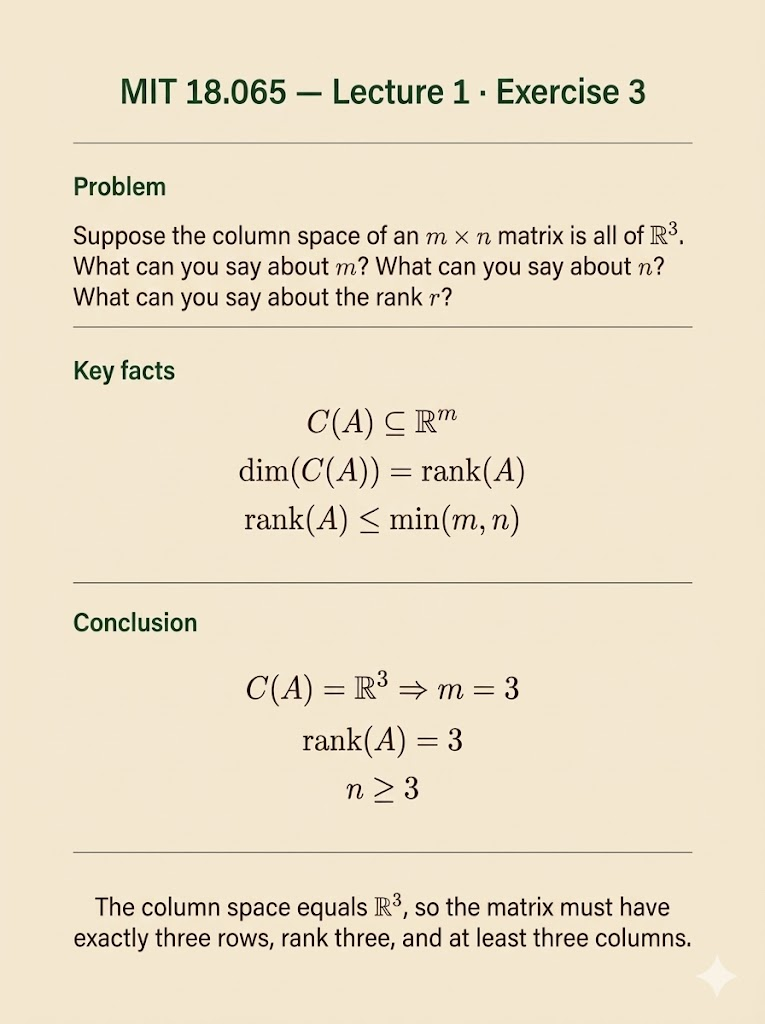
3. Column Space Equals \(\mathbb{R}^3\)
If the column space of an \(m \times n\) matrix is all of \(\mathbb{R}^3\), what can you say about \(m\), \(n\), and the rank?
- \(m=3\)
- \(n \ge 3\)
- \(\text{rank}(A)=3\)
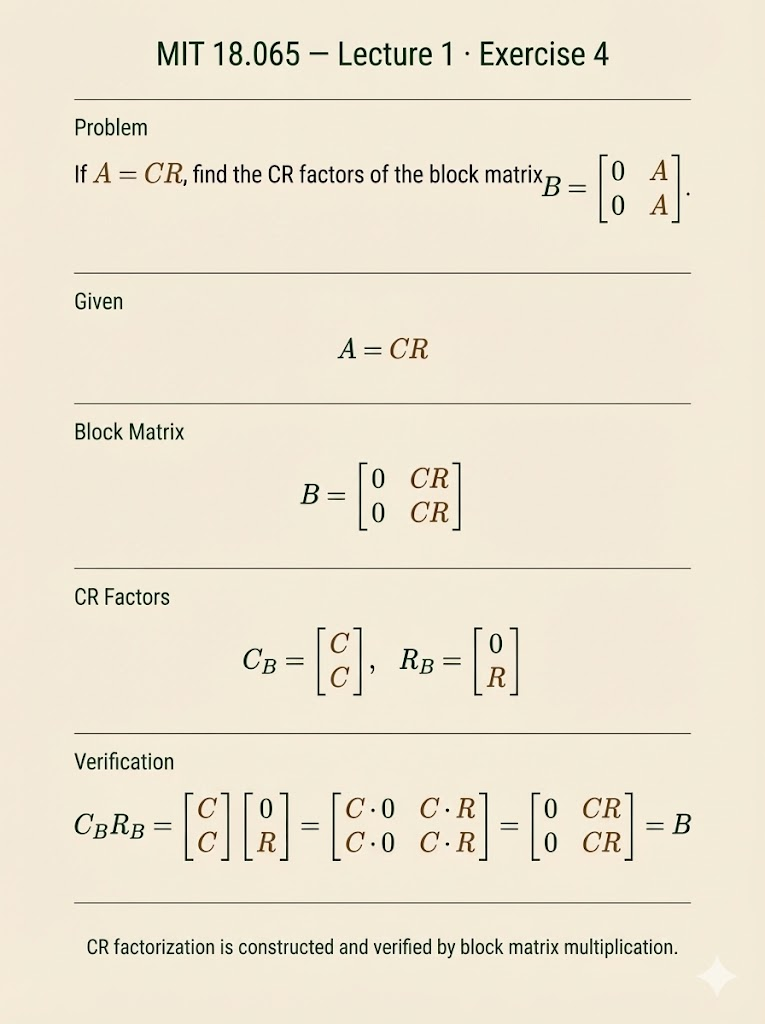
4. CR Factorization Block Matrix
If \(A=CR\), find the CR factors of \[ B=\begin{bmatrix}0 & A\\ 0 & A\end{bmatrix}. \]
\[ B= \begin{bmatrix}0 & CR\\ 0 & CR\end{bmatrix} = \begin{bmatrix}C\\ C\end{bmatrix} \begin{bmatrix}0 & R\end{bmatrix} \]
So \[ C_B=\begin{bmatrix}C\\ C\end{bmatrix}, \quad R_B=\begin{bmatrix}0 & R\end{bmatrix} \]