Gilbert Strang’s Calculus: Product Rule and Quotient Rule
Product
Let \[ p(x)=f(x)g(x). \] Then \[ \frac{dp}{dx}=f(x)\frac{dg}{dx}+g(x)\frac{df}{dx}. \]
Examples
- \(f(x)=x^2,\ g(x)=x\)
Product rule gives \[ \frac{d}{dx}(x^3)=x^2+x\cdot 2x=3x^2. \] - \(f(x)=x^3,\ g(x)=x\)
Product rule gives \[ \frac{d}{dx}(x^4)=x^3+x\cdot 3x^2=4x^3. \]
These examples match the power-rule pattern \[ \frac{d}{dx}(x^n)=nx^{n-1}. \]
Derivative of \(\frac{d}{dx}(f(x))^n\)
For \(n=2\): \[ \frac{d}{dx}(f(x))^2=f(x)\frac{df}{dx}+f(x)\frac{df}{dx}=2f(x)\frac{df}{dx}. \]
For \(n=3\), write \(f(x)^3=f(x)^2f(x)\): \[ \frac{d}{dx}(f(x)^3)=f(x)\,\frac{d}{dx}(f(x)^2)+f(x)^2\frac{df}{dx} =3f(x)^2\frac{df}{dx}. \]
So the pattern is \[ \frac{d}{dx}(f(x)^n)=n f(x)^{n-1}\frac{df}{dx}. \]
Derivative of square root
Let \(f(x)=\sqrt{x}\). Since \((\sqrt{x})^2=x\): \[ \frac{d}{dx}(\sqrt{x})^2=2\sqrt{x}\,\frac{d}{dx}(\sqrt{x})=1. \] Hence \[ \frac{d}{dx}(\sqrt{x})=\frac{1}{2\sqrt{x}}=\frac{1}{2}x^{-1/2}, \] which also matches the power rule with \(n=\frac12\).
Explanation (geometric intuition)
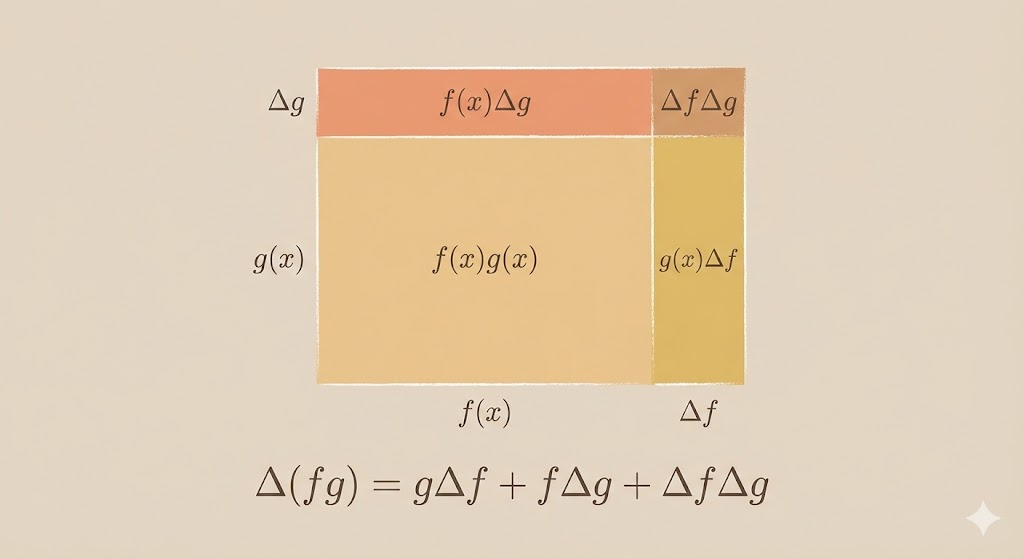
View \(p(x)=f(x)g(x)\) as the area of a rectangle. When \(x\) increases by \(\Delta x\):
- \(\Delta f=f(x+\Delta x)-f(x)\)
- \(\Delta g=g(x+\Delta x)-g(x)\)
The area increase has three parts:
- \(g\,\Delta f\)
- \(f\,\Delta g\)
- \(\Delta f\,\Delta g\)
So \[ \Delta p=f\,\Delta g+g\,\Delta f+\Delta f\,\Delta g. \] Divide by \(\Delta x\): \[ \frac{\Delta p}{\Delta x}=f\frac{\Delta g}{\Delta x}+g\frac{\Delta f}{\Delta x}+\Delta g\left(\frac{\Delta f}{\Delta x}\right). \] As \(\Delta x\to 0\), we have \(\Delta g\to 0\), so the last term vanishes. Therefore: \[ \frac{dp}{dx}=f(x)g'(x)+g(x)f'(x). \]
Quotient
Let \[ q(x)=\frac{f(x)}{g(x)}\quad (g(x)\neq 0). \] To get \(q'(x)\), start from \[ f(x)=g(x)q(x). \] Differentiate: \[ \frac{df}{dx}=g(x)\frac{dq}{dx}+q(x)\frac{dg}{dx} = g(x)\frac{dq}{dx}+\frac{f(x)}{g(x)}\frac{dg}{dx}. \] Multiply by \(g(x)\): \[ g(x)\frac{df}{dx}-f(x)\frac{dg}{dx}=g(x)^2\frac{dq}{dx}. \] So \[ \frac{dq}{dx}=\frac{g(x)f'(x)-f(x)g'(x)}{(g(x))^2}. \]
Example
Take
- \(f(x)=1\)
- \(g(x)=x^n\)
- \(q(x)=\frac{1}{x^n}=x^{-n}\)
Known derivatives:
- \(f'(x)=0\)
- \(g'(x)=n x^{n-1}\)
Apply quotient rule: \[ q'(x)=\frac{x^n\cdot 0-1\cdot n x^{n-1}}{x^{2n}} =-n x^{-n-1}. \] This matches differentiating \(x^{-n}\) directly by the power rule.
Takeaway. Product and quotient rules are not isolated formulas. They are consistent with power-rule patterns and have a clean geometric interpretation through small area changes.