Gilbert Strang’s Calculus: Limits and Continuous Functions
Limit Definition
Limits are intuitive (“approach a value”), but calculus needs a strict definition.
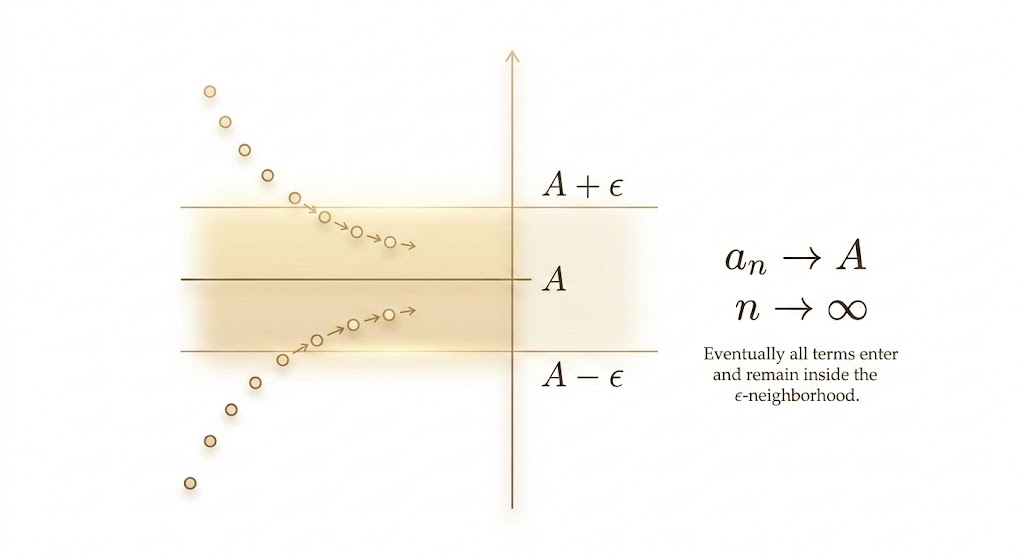
For a sequence \(a_n\), write \[ \lim_{n\to\infty} a_n = A \] if for every \(\epsilon>0\), there exists an integer \(N\) such that for all \(n>N\), \[ |a_n-A|<\epsilon. \]
This is the \(\epsilon\)-\(N\) definition: eventually, all terms stay within any target tolerance around \(A\).
Properties of Limit
If \(\lim_{n\to\infty} a_n=A\) and \(\lim_{n\to\infty} b_n=B\), then:
- \(a_n \pm b_n \to A \pm B\)
- \(a_n b_n \to AB\)
- \(a_n / b_n \to A/B\) when \(B\neq 0\)
- \((a_n)^{b_n} \to A^B\) in regular cases
Dangerous!
For these properties, special endpoint cases become indeterminate forms:
- In subtraction, if both limits are \(\infty\), then \(\infty-\infty\) is indeterminate.
- In multiplication, if limits are \(0\) and \(\infty\), then \(0\cdot\infty\) is indeterminate.
- In division:
- if both limits are \(0\), then \(0/0\) is indeterminate.
- if both limits are \(\infty\), then \(\infty/\infty\) is indeterminate.
- In powers:
- if base and exponent limits are both \(0\), then \(0^0\) is indeterminate.
- if base tends to \(1\) and exponent tends to \(\infty\), then \(1^\infty\) is indeterminate.
- if base tends to \(\infty\) and exponent tends to \(0\), then \(\infty^0\) is indeterminate.
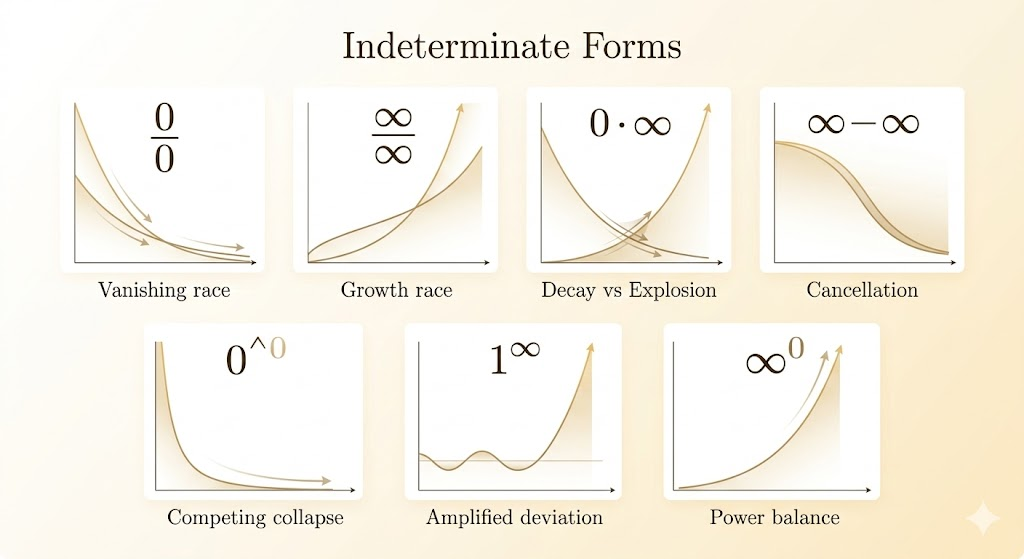
Here are the 7 indeterminate forms (grouped as in your note):
- Quotients (Fractions)
- \(0/0\) (Numerator pulls to 0; Denominator pulls to \(\infty\))
- \(\infty/\infty\) (Numerator pulls to \(\infty\); Denominator pulls to 0)
- Products (Multiplication)
- \(0\cdot\infty\) (One factor pulls to 0; the other pulls to \(\infty\))
- Differences (Subtraction)
- \(\infty-\infty\) (Both terms pull the result in opposite directions)
- Exponents (Powers)
- \(0^0\) (Base pulls to 0; Exponent pulls to 1)
- \(1^\infty\) (Base pulls to 1; Exponent pulls to \(\infty\) or 0)
- \(\infty^0\) (Base pulls to \(\infty\); Exponent pulls to 1)
Different function pairs can produce different limits for the same symbolic form.
Correction note: in standard limit notation, \(0/0\) means numerator and denominator both tend to \(0\), and \(\infty/\infty\) means both tend to \(\infty\).
Indeterminate Form Example: \(1^\infty\)
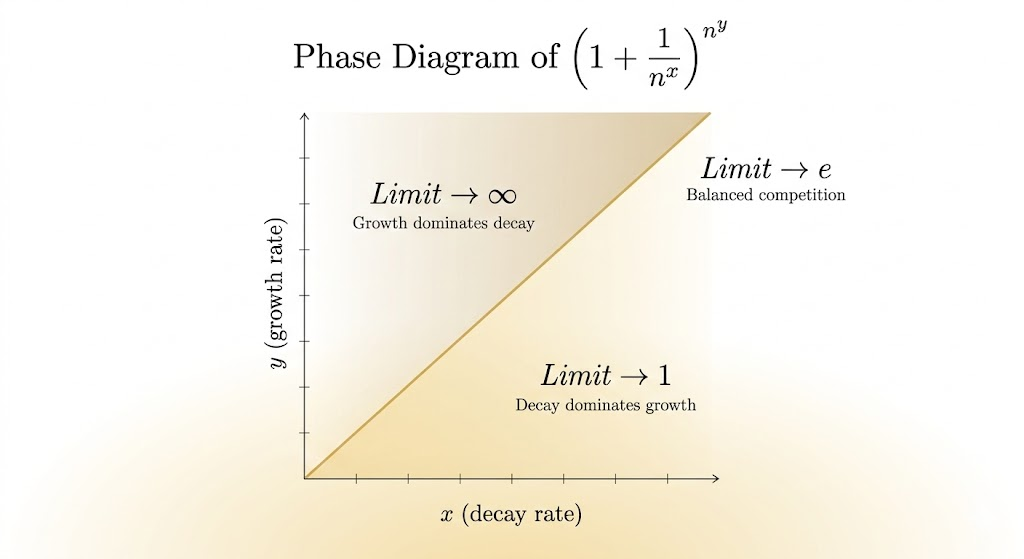
Let \[ f_n = 1+\frac{1}{n^x}, \qquad g_n=n^y \] with positive integers \(x,y\). Then \[ \lim_{n\to\infty}\left(1+\frac{1}{n^x}\right)^{n^y} \] has type \(1^\infty\).
Use logs: \[ \log L_n=n^y\log(1+n^{-x})\sim n^y\cdot n^{-x}=n^{y-x}. \]
So the result depends on \(x,y\):
- \(x=y \Rightarrow L_n\to e\)
- \(x>y \Rightarrow L_n\to 1\)
- \(x<y \Rightarrow L_n\to\infty\)
\(0/0\) and L’Hospital’s Rule
If \(f(x)\to 0\) and \(g(x)\to 0\) as \(x\to a\), the quotient is indeterminate.
L’Hospital’s rule compares rates of change: \[
\lim_{x\to a}\frac{f(x)}{g(x)}
=
\lim_{x\to a}\frac{f'(x)}{g'(x)},
\] when the rule’s conditions are satisfied.
This turns a static “zero divided by zero” into a dynamic comparison of speeds.
Example: \[ f(x)=\frac{1}{x},\quad g(x)=\frac{1}{x^2},\quad x\to\infty. \] Then \[ f'(x)=-\frac{1}{x^2},\quad g'(x)=-\frac{2}{x^3}, \] and \[ \frac{f'(x)}{g'(x)}=\frac{x}{2}\to\infty. \] Hence \[ \lim_{x\to\infty}\frac{(1/x)}{(1/x^2)}=\infty. \]
Continuous Function
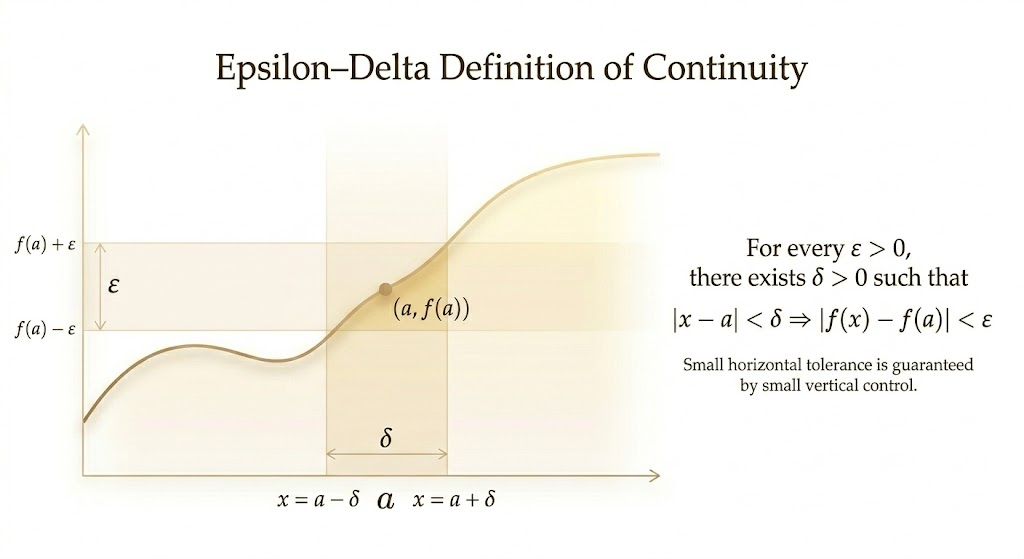
A function \(f\) is continuous at \(x=a\) if \[ \lim_{x\to a}f(x)=f(a). \]
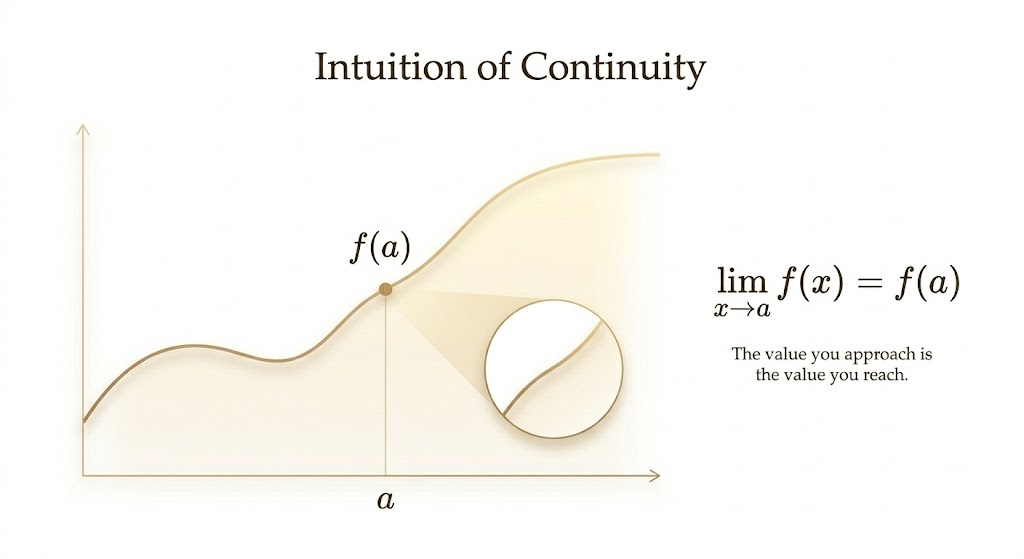
Formal \(\epsilon\)-\(\delta\) definition:
for every \(\epsilon>0\), there exists \(\delta>0\) such that \[
|x-a|<\delta \Longrightarrow |f(x)-f(a)|<\epsilon.
\]
A Famous Non-Continuous Function
\[ f(x)=\sin\left(\frac{1}{x}\right) \] is not continuous at \(x=0\) because it oscillates infinitely between \(-1\) and \(1\) as \(x\to 0\), so the limit does not exist.
Connection Between Limit and Continuity
Continuity means: as we shrink the neighborhood around \(a\), the limit agrees with the actual value at \(a\).
When this local condition holds at every point in a domain, the function is continuous on that domain.
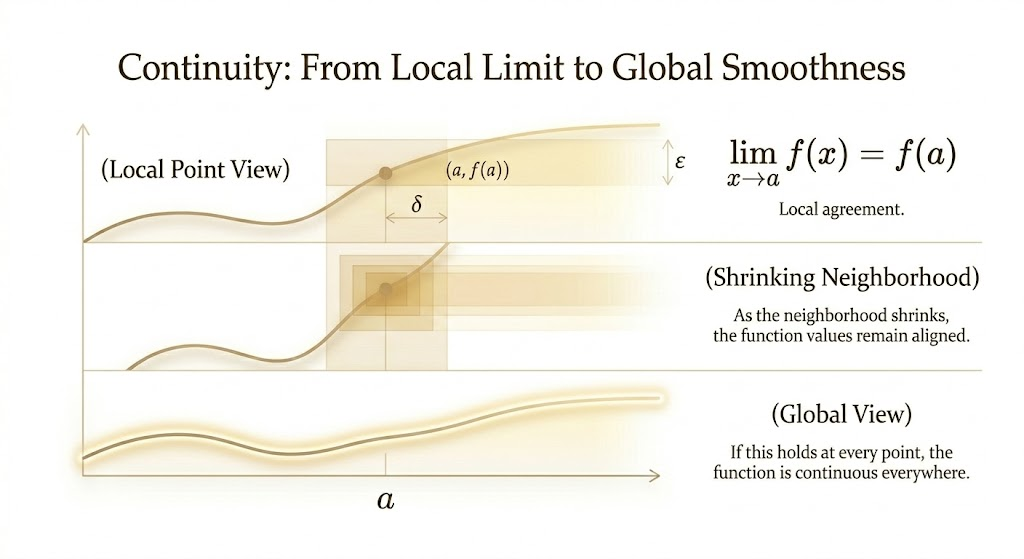
Takeaway. Limits describe approach, and continuity requires that approach value to match function value.