Gilbert Strang’s Calculus: Chains and the Chain Rule
Chain Function
A chain (composite) function has the form \[ f(g(x)). \]
Chain Rule
If \[ z=f(y),\quad y=g(x), \] then \[ \frac{dz}{dx}=\frac{dz}{dy}\frac{dy}{dx}. \]
Examples
For \[ f(x)=\sin(3x): \]
- \(z=\sin y\)
- \(y=3x\)
\[ \frac{dz}{dy}=\cos y,\qquad \frac{dy}{dx}=3, \] so \[ \frac{dz}{dx}=3\cos y=3\cos(3x). \]
For \[ f(x)=(x^3)^2: \]
- \(z=y^2\)
- \(y=x^3\)
\[ \frac{dz}{dy}=2y,\qquad \frac{dy}{dx}=3x^2, \] therefore \[ \frac{dz}{dx}=\frac{dz}{dy}\frac{dy}{dx}=2y\cdot 3x^2=6x^5. \]
Another example: \[ f(x)=\frac{1}{\sqrt{1-x^2}}=(1-x^2)^{-1/2}. \]
- \(z=y^{-1/2}\)
- \(y=1-x^2\)
\[ \frac{dz}{dy}=-\frac{1}{2}y^{-3/2},\qquad \frac{dy}{dx}=-2x, \] so \[ \frac{dz}{dx}=\left(-\frac{1}{2}y^{-3/2}\right)(-2x)=x(1-x^2)^{-3/2}. \]
Why the Chain Rule works
Write the overall rate with an intermediate step: \[ \frac{\Delta z}{\Delta x}=\frac{\Delta z}{\Delta y}\cdot\frac{\Delta y}{\Delta x}. \]
This is exactly the “break-down” idea: a nested function changes in two stages, and total sensitivity is the product of stage sensitivities.
As \(\Delta x\to 0\), these difference quotients become derivatives: \[ \frac{dz}{dx}=\frac{dz}{dy}\frac{dy}{dx}. \]
Chained Exponential Function
Take \[ f(x)=e^{-x^2/2}. \] Set - \(y=-\frac{x^2}{2}\) - \(z=e^y\)
Then \[ \frac{dz}{dy}=e^y,\qquad \frac{dy}{dx}=-x, \] so \[ \frac{dz}{dx}=e^y(-x)=-x e^{-x^2/2}. \]
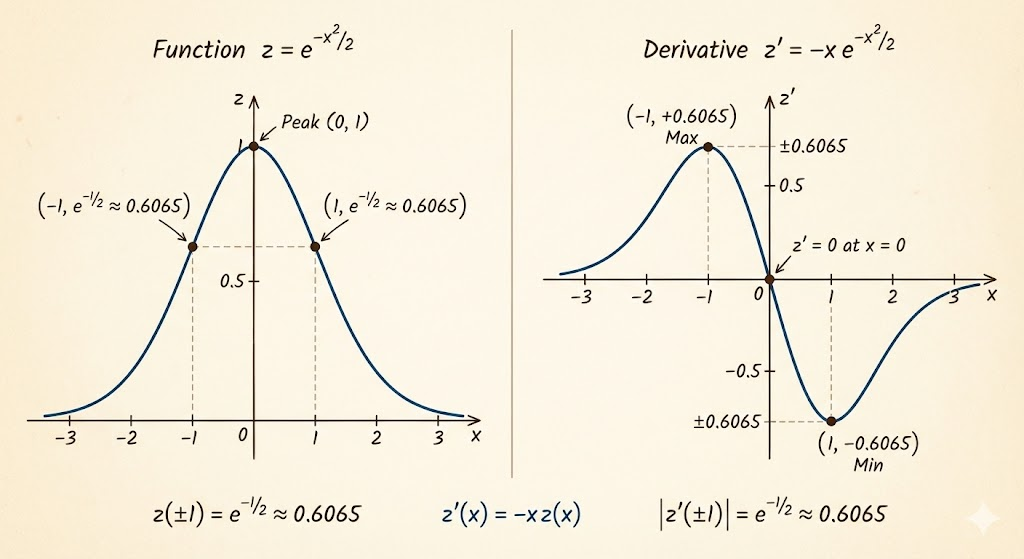
As the bell-shaped curve rises to its peak and then decays, the slope moves from positive to zero (at the top) and then negative.
Why are the maximum and minimum of \(z'(x)\) at \(x=1\) and \(x=-1\)? Because \(z''(x)=0\) at these two points.
Now compute the second derivative: \[ \frac{dz}{dx}=-x e^{-x^2/2}. \] Use product rule with - \(a(x)=-x\) - \(b(x)=e^{-x^2/2}\)
Then \[ a'(x)=-1,\qquad b'(x)=-x e^{-x^2/2}, \] and \[ \frac{d^2z}{dx^2}=a(x)b'(x)+a'(x)b(x) = (-x)(-x e^{-x^2/2})+(-1)e^{-x^2/2} = (x^2-1)e^{-x^2/2}. \]
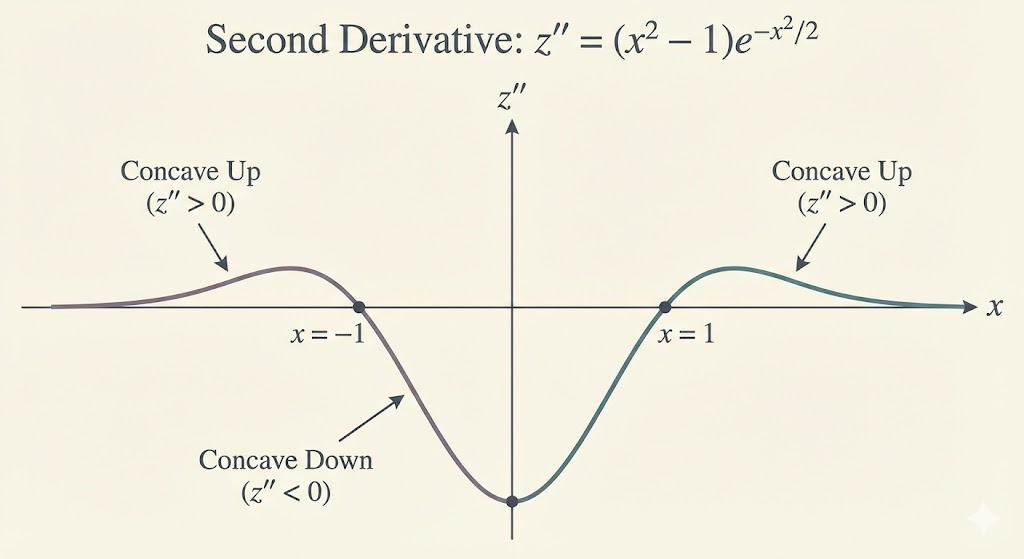
The second derivative explains where curvature changes: central concave-down behavior with concave-up behavior in outer regions.
Takeaway. Chain rule decomposes complicated derivatives into a sequence of simpler derivatives. Combined with product rule, it gives clean first- and second-derivative formulas for important functions like the Gaussian shape \(e^{-x^2/2}\).