Generative Adversarial Nets
Paper: Generative Adversarial Nets
At its core, a GAN is a dynamic minimax game: we train the discriminator \(D\) to detect fake samples, and the generator \(G\) to deceive \(D\). In this adversarial loop, every upgrade in \(D\)’s scrutiny becomes the training signal that pushes \(G\) toward more realistic generation.
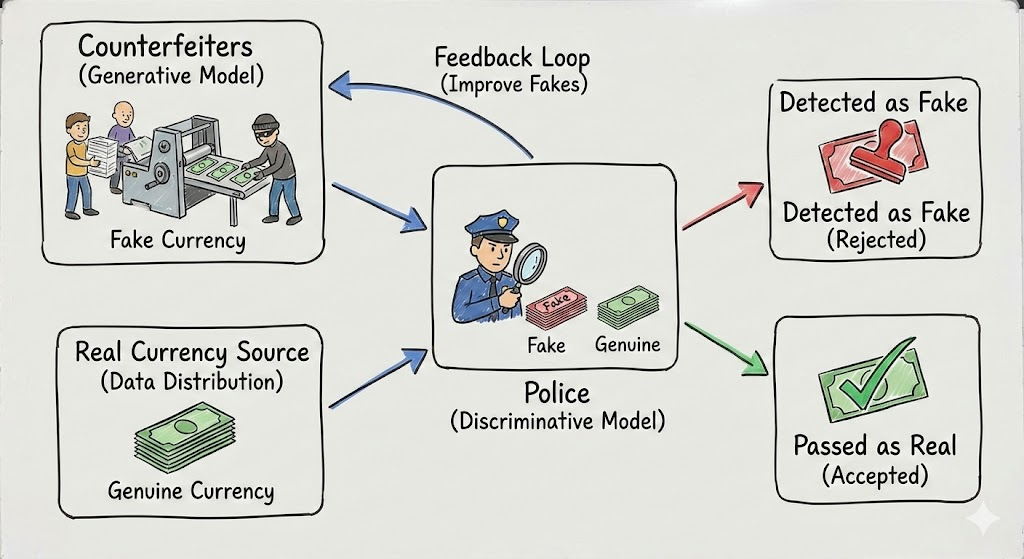
Adversarial Net
Two Distributions: Real vs. Fake
- \(p_{data}(x)\): probability density of sample \(x\) from the true data distribution (real).
- \(p_g(x)\): probability density of sample \(x\) from the generated distribution (fake), induced by \(x=G(z), z\sim p_z(z)\).
Two Players: Discriminator (Police) vs. Generator (Counterfeiters)
- Discriminator \(D\): tries to distinguish real data from fake data; it should not be fooled by the generator.
- Generator \(G\): tries to produce fake data realistic enough to fool the discriminator.
Min-Max Objective
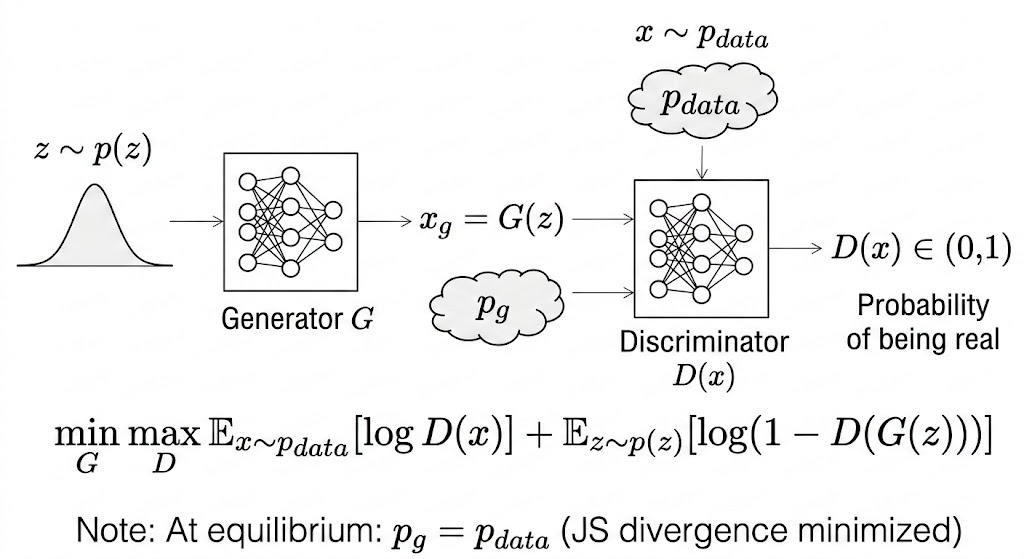
\[ \min_G \max_D V(D,G) = \mathbb{E}_{x\sim p_{data}}[\log D(x)] + \mathbb{E}_{z\sim p_z}[\log(1-D(G(z)))]. \]
1. Core variables
- \(D(x)\): discriminator confidence that sample \(x\) is real, in \([0,1]\).
- \(D(G(z))\): discriminator confidence that generated sample \(G(z)\) is real, in \([0,1]\).
2. Maximize \(D\) (discriminator phase)
Given fixed \(G\), discriminator updates aim to maximize \(V(D,G)\):
- push \(D(x)\to 1\) for real samples,
- push \(D(G(z))\to 0\) for generated samples.
3. Minimize \(G\) (generator phase)
Given fixed \(D\), generator updates aim to make generated samples look real:
- increase \(D(G(z))\) toward \(1\),
- make \(\log(1-D(G(z)))\) smaller.
This is why the paper writes generator training as a minimization in the minimax objective.
In practice, many implementations use the non-saturating generator loss \(-\log D(G(z))\) for stronger gradients early in training.
Training alternates:
- Update \(D\) with real and generated batches.
- Update \(G\) through gradients from \(D\).
Theory
Global optimality: optimal discriminator for fixed generator
For fixed \(G\), the optimal discriminator is
\[ D_G^*(x)=\frac{p_{data}(x)}{p_{data}(x)+p_g(x)}. \]
Start from
\[ V(D,G)=\int p_{data}(x)\log D(x)\,dx + \int p_g(x)\log(1-D(x))\,dx. \]
In the original derivation, the second expectation over \(z\) is rewritten in \(x\)-space using the induced model density \(p_g(x)\).
For each fixed \(x\), maximize
\[ f(y)=a\log y + b\log(1-y), \quad y\in(0,1) \]
with \(a=p_{data}(x), b=p_g(x)\).
\[ f'(y)=\frac{a}{y}-\frac{b}{1-y}=0 \quad\Rightarrow\quad y^*=\frac{a}{a+b}. \]
And
\[ f''(y)=-\frac{a}{y^2}-\frac{b}{(1-y)^2}<0, \]
so this critical point is the maximum. Therefore,
\[ D_G^*(x)=\frac{p_{data}(x)}{p_{data}(x)+p_g(x)}. \]
Intuition: the optimal discriminator compares relative density proportions.
- If \(p_{data}(x)=0.8\) and \(p_g(x)=0.8\), then \(D_G^*(x)=0.5\).
- If \(p_{data}(x)=0.8\) and \(p_g(x)=0.2\), then \(D_G^*(x)=0.8\).
\(C(G)\) and the global minimum
Define
\[ C(G)=\max_D V(D,G)=V(D_G^*,G). \]
The GAN paper shows
\[ C(G) = -\log 4 + 2\,\mathrm{JSD}(p_{data}\|p_g), \]
so the global minimum is reached when
\[ p_g=p_{data}, \]
and then
\[ C(G)=-\log 4, \]
with optimal discriminator output \(D(x)=\tfrac{1}{2}\) everywhere.
In words: when generated and real distributions match exactly, the discriminator cannot do better than random guessing.
The paper’s proof perspective is that this objective has a unique minimum at \(p_g=p_{data}\), which is the desired target distribution.
Why This Paper Matters
- It introduced implicit generative modeling trained by adversarial feedback.
- It avoided explicit likelihood design for many complex data distributions.
- It established a new line of generative-model research (DCGAN, conditional GANs, Wasserstein GAN, etc.).
Takeaway. GANs frame generation as a game between a forger and a detector. The detector’s improving boundary is exactly the training signal that pushes the generator toward the real data distribution.