Gilbert Strang’s Calculus: Power Series and Euler’s Great Formula
This lecture shows how derivatives at a single point can generate an entire function locally. Power series turn differentiation patterns into explicit formulas, and Euler’s formula appears when the exponential series is evaluated at an imaginary input.
Power Series from Derivatives
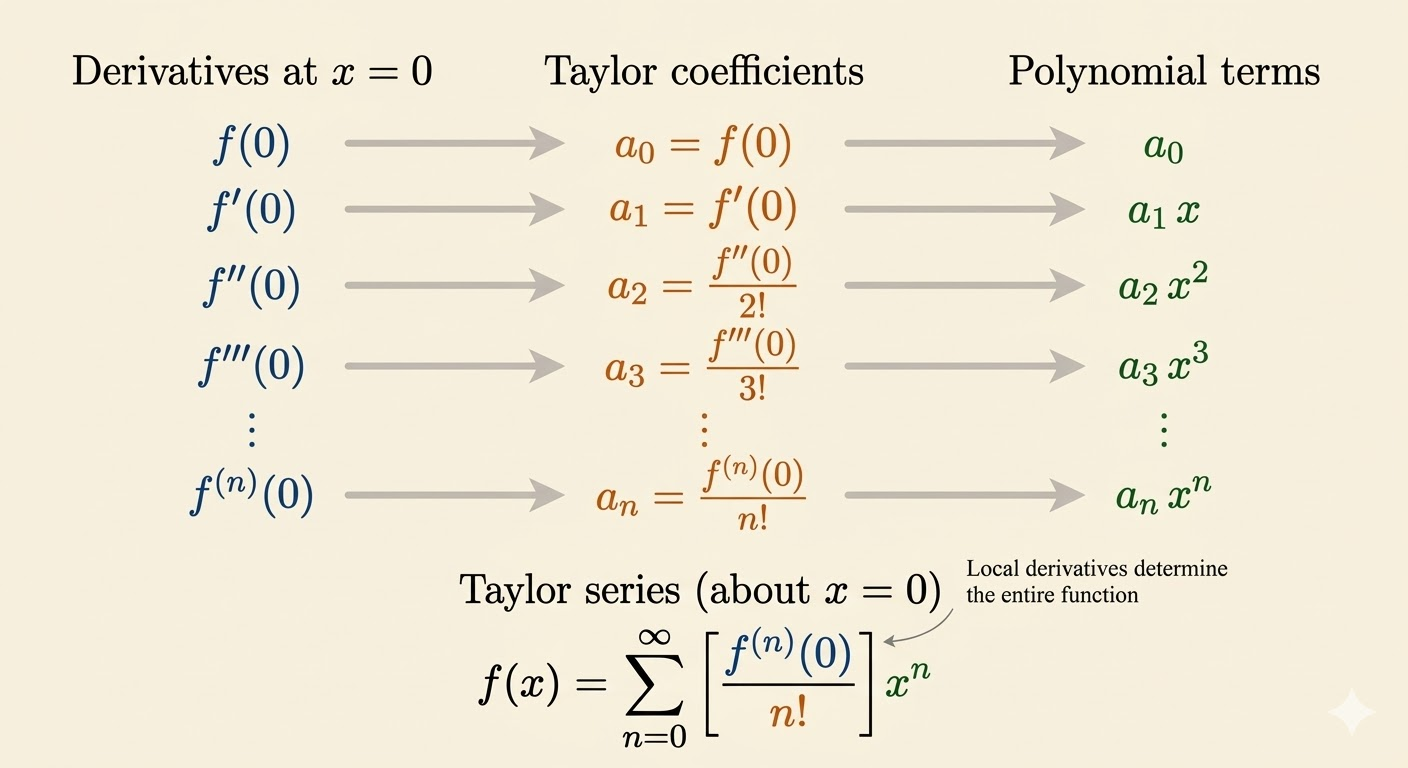
Start with a power series centered at \(x=0\):
\[ f(x)=a_0+a_1x+a_2x^2+a_3x^3+\cdots. \]
Successive derivatives reveal the coefficients:
- \(f(0)=a_0\)
- \(f'(0)=a_1\)
- \(f''(0)=2!a_2\)
- \(f^{(3)}(0)=3!a_3\)
In general,
\[ a_n=\frac{f^{(n)}(0)}{n!}. \]
So the Taylor series at \(x=0\) is
\[ f(x)=\sum_{n=0}^{\infty}\frac{f^{(n)}(0)}{n!}x^n. \]
Exponential
For \(f(x)=e^x\), every derivative is still \(e^x\). At \(x=0\),
\[ f(0)=f'(0)=f''(0)=\cdots=1. \]
Therefore
\[ e^x=1+x+\frac{x^2}{2!}+\frac{x^3}{3!}+\frac{x^4}{4!}+\cdots =\sum_{n=0}^{\infty}\frac{x^n}{n!}. \]
This is the cleanest example of a power series because the derivative pattern never changes.
Sine and Cosine
For \(\sin x\), the derivatives cycle:
\[ \sin x,\quad \cos x,\quad -\sin x,\quad -\cos x,\quad \sin x,\dots \]
Evaluating at \(x=0\) gives
\[ \sin 0=0,\qquad \cos 0=1. \]
So the coefficients alternate and the even powers vanish:
\[ \sin x=x-\frac{x^3}{3!}+\frac{x^5}{5!}-\frac{x^7}{7!}+\cdots. \]
For \(\cos x\), the derivative cycle is
\[ \cos x,\quad -\sin x,\quad -\cos x,\quad \sin x,\quad \cos x,\dots \]
Again at \(x=0\),
\[ \cos 0=1,\qquad \sin 0=0. \]
So the odd powers vanish and the even powers alternate:
\[ \cos x=1-\frac{x^2}{2!}+\frac{x^4}{4!}-\frac{x^6}{6!}+\frac{x^8}{8!}-\cdots. \]
Euler’s Great Formula
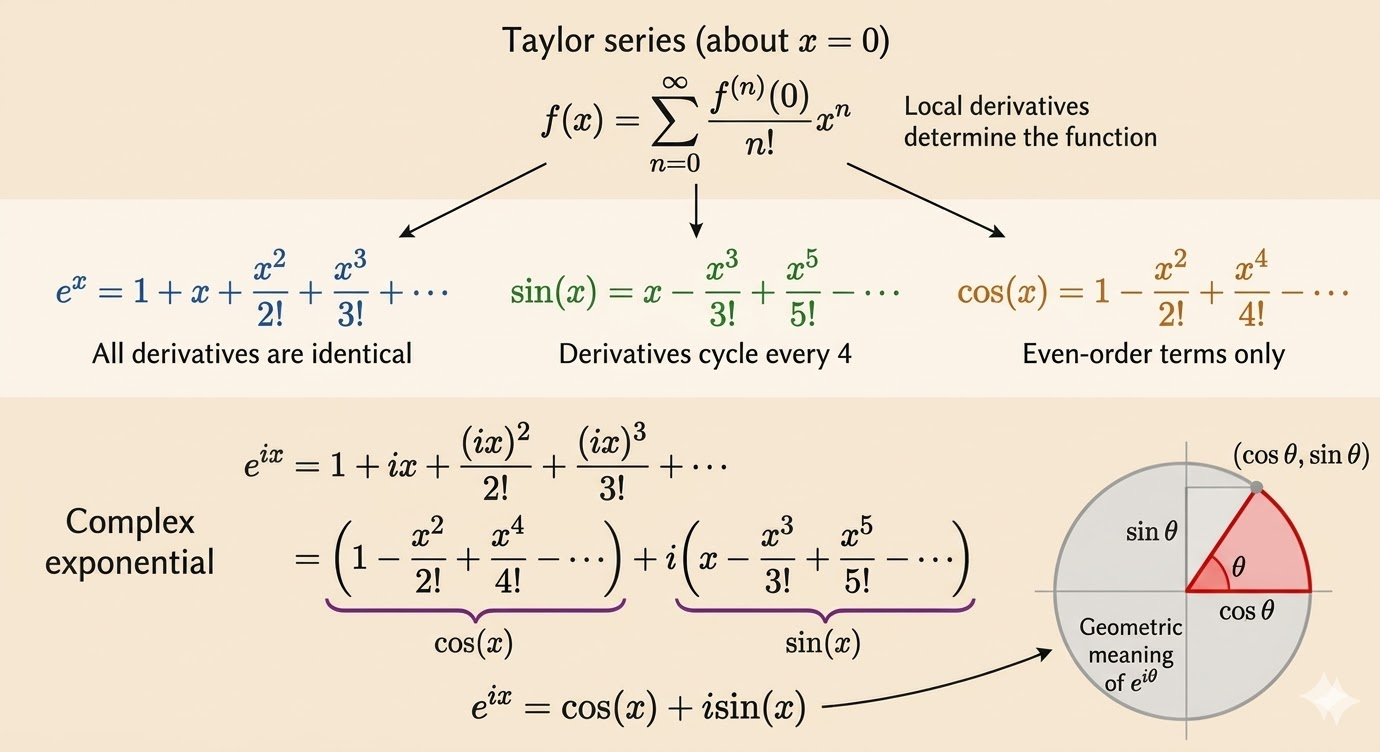
Now substitute \(ix\) into the exponential series, where \(i^2=-1\):
\[ e^{ix}=1+ix+\frac{(ix)^2}{2!}+\frac{(ix)^3}{3!}+\frac{(ix)^4}{4!}+\cdots. \]
Separate the even and odd powers:
\[ e^{ix}= \left(1-\frac{x^2}{2!}+\frac{x^4}{4!}-\cdots\right) +i\left(x-\frac{x^3}{3!}+\frac{x^5}{5!}-\cdots\right). \]
Those two series are exactly \(\cos x\) and \(\sin x\), so
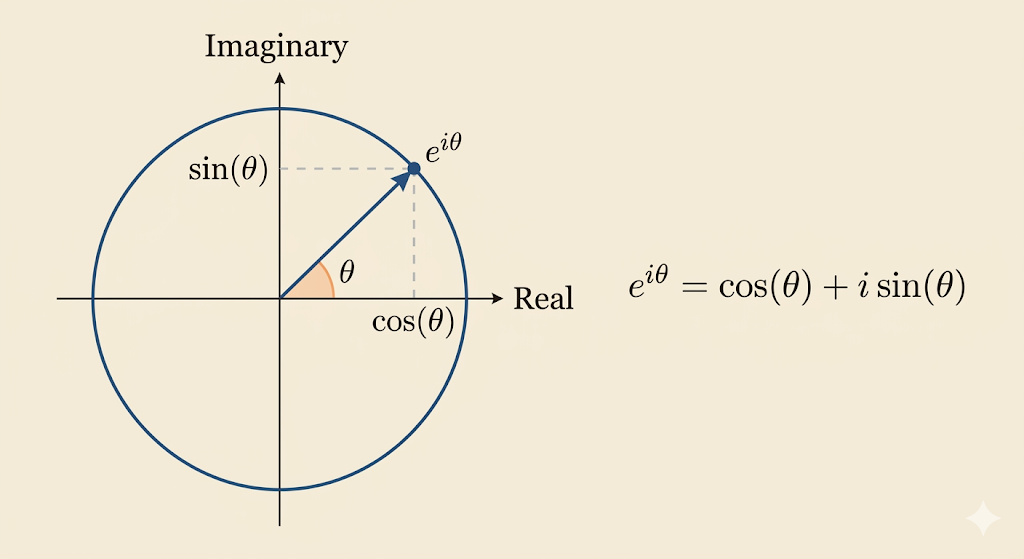
\[ e^{ix}=\cos x+i\sin x. \]
More generally,
\[ e^{i\theta}=\cos \theta+i\sin \theta. \]
This is Euler’s great formula: the exponential function, trigonometric functions, and complex numbers all meet in one identity.
Geometric and Logarithmic Series
Two other important series in this lecture are
\[ \frac{1}{1-x}=1+x+x^2+x^3+\cdots \]
and
\[ -\ln(1-x)=x+\frac{x^2}{2}+\frac{x^3}{3}+\cdots. \]
The geometric series can be derived directly, and the logarithmic series follows by integrating term by term:
\[ \int \frac{1}{1-x}\,dx = \int (1+x+x^2+x^3+\cdots)\,dx. \]
This gives
\[ -\ln(1-x)=x+\frac{x^2}{2}+\frac{x^3}{3}+\frac{x^4}{4}+\cdots. \]
These two series come with an important restriction:
\[ |x|<1. \]
The reason is structural. Both functions have a singularity at \(x=1\), so a series centered at \(x=0\) cannot keep converging past that distance.
Takeaways
- Derivatives at one point determine the Taylor-series coefficients.
- The derivative cycles of \(\sin x\) and \(\cos x\) explain their alternating odd/even series.
- Substituting an imaginary input into \(e^x\) produces Euler’s formula.
- Geometric and logarithmic series show that power-series manipulations also reveal convergence limits.
Source: Gilbert Strang’s Calculus lecture on power series and Euler’s great formula.