Gilbert Strang’s Calculus: Derivatives of ln y and arcsin(y)
Inverse functions let us turn a known derivative into a new one by reversing the map. This note uses that idea twice: first for the logarithm as the inverse of the exponential, then for arcsine as the inverse of sine.
Inverse Functions
An inverse function undoes the effect of another function.
If
\[ y = f(x), \]
then the inverse function sends \(y\) back to \(x\):
\[ x = f^{-1}(y). \]
The two identities are
\[ f^{-1}(f(x)) = x, \qquad f(f^{-1}(y)) = y. \]
Example: A Linear Function
Start with
\[ f(x) = ax + b. \]
To find the inverse, solve for \(x\) in terms of \(y\):
\[ y = ax + b \]
\[ y - b = ax \]
\[ x = \frac{y-b}{a}. \]
So the inverse function is
\[ f^{-1}(y) = \frac{y-b}{a}. \]
Derivative of \(\ln y\)
The logarithm is the inverse of the exponential function. If
\[ y = e^x, \]
then
\[ x = \ln y. \]
Differentiate \(y=e^x\) with respect to \(x\):
\[ \frac{dy}{dx} = e^x = y. \]
Now invert the derivative:
\[ \frac{dx}{dy} = \frac{1}{dy/dx} = \frac{1}{y}. \]
Since \(x = \ln y\), this gives
\[ \frac{d}{dy}(\ln y) = \frac{1}{y}, \qquad y>0. \]
The Missing Power
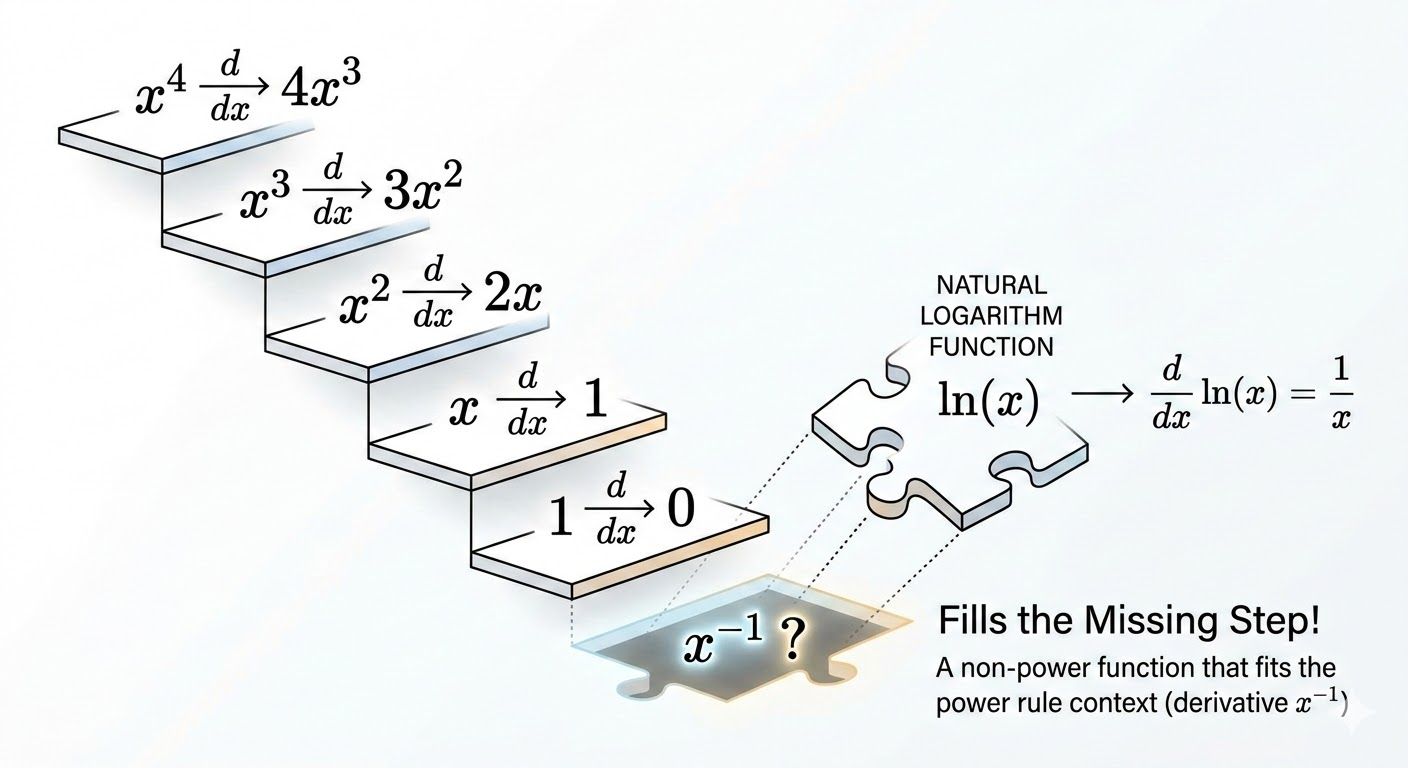
The power rule says
\[ \frac{d}{dy}(y^n) = ny^{n-1}. \]
Examples:
- \(\frac{d}{dy}(y^3) = 3y^2\)
- \(\frac{d}{dy}(y^2) = 2y\)
- \(\frac{d}{dy}(y) = 1\)
Each derivative lowers the exponent by one. But when \(n=0\), the chain breaks:
\[ \frac{d}{dy}(y^0) = \frac{d}{dy}(1) = 0. \]
So the derivative never naturally produces the power \(y^{-1}\).
That missing derivative is supplied by the logarithm:
\[ \frac{d}{dy}(\ln y) = \frac{1}{y}. \]
This is one of the beautiful pattern-completion moments in calculus: logarithms fill the gap left by the power rule.
Derivative of \(\arcsin(y)\)
Start with the inverse-sine definition:
\[ x = \sin^{-1}(y) = \arcsin(y). \]
That means
\[ y = \sin x. \]
Differentiate both sides with respect to \(y\):
\[ \frac{d}{dy}(y) = \frac{d}{dy}(\sin x). \]
The left side is \(1\). The right side uses the chain rule:
\[ 1 = \cos x \cdot \frac{dx}{dy}. \]
So
\[ \frac{dx}{dy} = \frac{1}{\cos x}. \]
We still need to rewrite the answer in terms of \(y\) instead of \(x\). Since \(y = \sin x\), draw a right triangle with
- hypotenuse \(=1\)
- opposite side \(=y\)
Then the adjacent side is
\[ \sqrt{1-y^2}, \]
so
\[ \cos x = \frac{\sqrt{1-y^2}}{1} = \sqrt{1-y^2}. \]
Substitute back:
\[ \frac{dx}{dy} = \frac{1}{\sqrt{1-y^2}}. \]
Since \(x=\arcsin(y)\),
\[ \frac{d}{dy}(\arcsin y) = \frac{1}{\sqrt{1-y^2}}, \qquad |y|<1. \]
The derivative blows up at \(y=\pm 1\), which is why the formula is stated on the open interval \((-1,1)\).
Takeaways
- Inverse functions let us derive new formulas by reversing known ones.
- The logarithm is the inverse of the exponential, which gives \(\frac{d}{dy}(\ln y)=\frac{1}{y}\).
- The logarithm fills the missing \(y^{-1}\) slot in the power-rule pattern.
- Arcsine is the inverse of sine, and its derivative comes from chain rule plus the right-triangle identity.
Source: Gilbert Strang’s Calculus lecture on derivatives of \(\ln y\) and \(\sin^{-1}(y)\).