Efficient AI Lecture 5: Quantization (Part I)
Less Bits, Less Energy
Low-bit arithmetic is cheaper than high-precision arithmetic.
| Operation | Bit-width | Energy [pJ] | Relative Cost vs 8b Int ADD |
|---|---|---|---|
| 8-bit Integer ADD | 8 | 0.03 | 1x |
| 32-bit Integer ADD | 32 | 0.1 | ~3.3x |
| 16-bit Floating-Point ADD | 16 | 0.4 | ~13x |
| 32-bit Floating-Point ADD | 32 | 0.9 | 30x |
| 8-bit Integer MULT | 8 | 0.2 | ~6.7x |
| 16-bit Floating-Point MULT | 16 | 1.1 | ~37x |
| 32-bit Integer MULT | 32 | 3.1 | ~103x |
| 32-bit Floating-Point MULT | 32 | 3.7 | ~123x |
That is the hardware motivation for quantization: fewer bits reduce energy, storage, and bandwidth pressure.
Numeric Data Types
Integer
- Unsigned integer uses all bits for nonnegative values in \([0,2^n-1]\).
- Sign-magnitude uses one sign bit plus magnitude bits, but it has both
+0and-0, which is awkward for hardware arithmetic. - Two’s complement is the standard representation because it makes signed arithmetic efficient and uniform.
Fixed-Point
A fixed-point number splits bits into:
- an integer part
- a fractional part using powers like \(2^{-1}, 2^{-2}, \dots\)
Its value is just the weighted sum of the active bits. Fixed-point is simpler than floating-point, but its range is limited by the fixed binary point.
Floating-Point
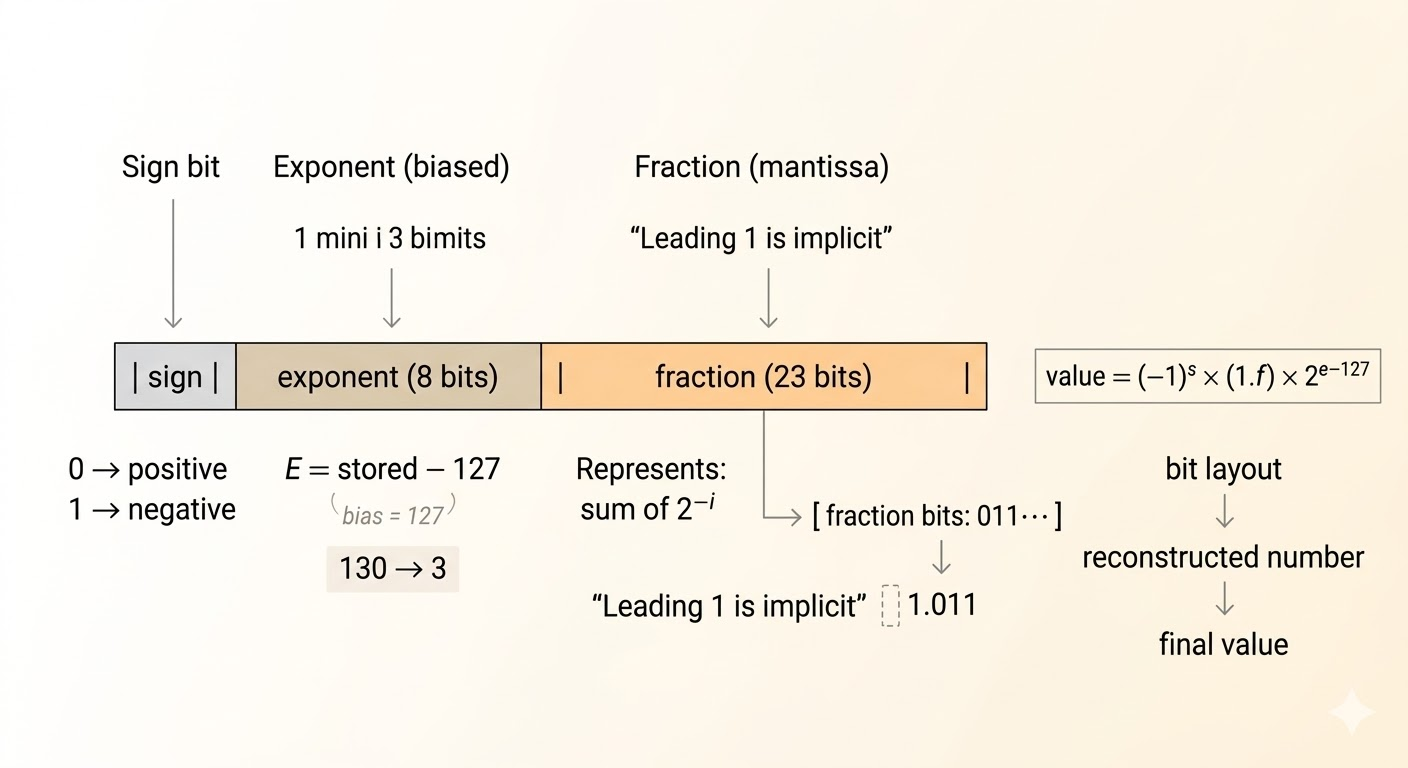
Floating-point stores three components:
- sign
- exponent
- fraction
For a normal IEEE FP32 number,
\[ \text{value} = (-1)^s (1.f)\,2^{e-127} \]
Key ideas:
- the leading
1is implicit for normal numbers, giving one extra bit of precision - the exponent is stored with a bias so hardware can compare exponents efficiently
Subnormals and Special Values
For IEEE-style floating point:
- exponent all
0, fraction all0:+0or-0 - exponent all
0, fraction nonzero: subnormal numbers - exponent all
1, fraction all0:+\inftyor-\infty - exponent all
1, fraction nonzero:NaN
Subnormals drop the hidden 1 and fill the gap between the smallest normal number and zero.
Different Precisions
- FP32: exponent
8, fraction23, sign1 - FP16: exponent
5, fraction10, sign1 - bfloat16: exponent
8, fraction7, sign1 - FP8
E4M3: exponent4, fraction3, sign1 - FP8
E5M2: exponent5, fraction2, sign1
There are also more aggressive low-bit formats such as INT4 and several FP4 variants.
Quantization
Quantization maps a continuous or high-precision set of values into a small discrete set.
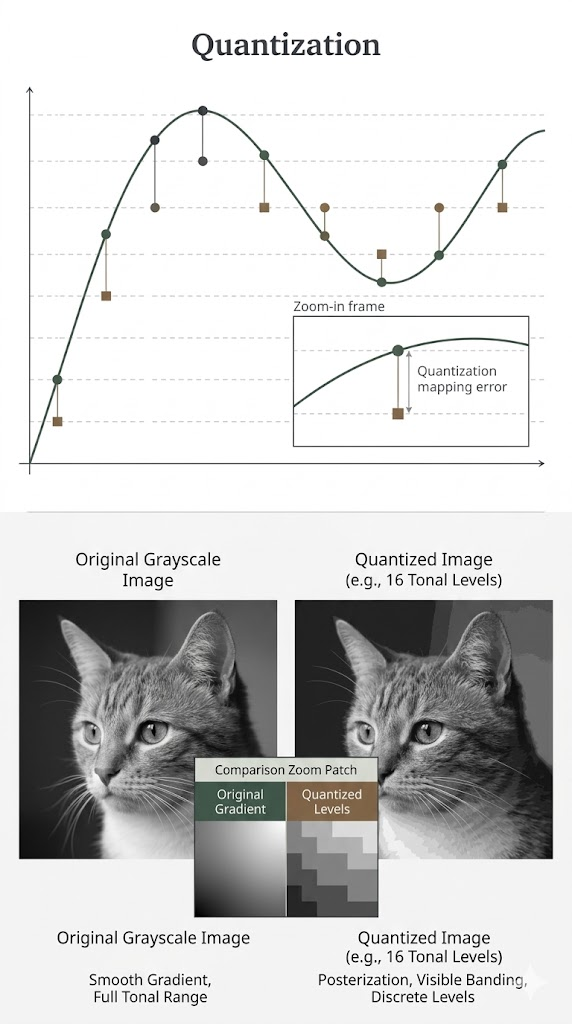
The goal is not only compression. It is also to make the hardware execute cheaper low-bit operations.
K-Means Quantization
K-means quantization works in three steps:
- Cluster similar FP32 weights.
- Replace each cluster by a centroid, forming a small shared codebook.
- Store only low-bit indices that point to the codebook entries.
This saves storage because large floating-point tensors become:
- a low-bit index matrix
- a tiny floating-point codebook
But the arithmetic itself is still not naturally low-bit. During execution, the indices usually have to be dequantized back to floating-point values. So:
- storage is compressed
- computation is not automatically accelerated
Linear Quantization
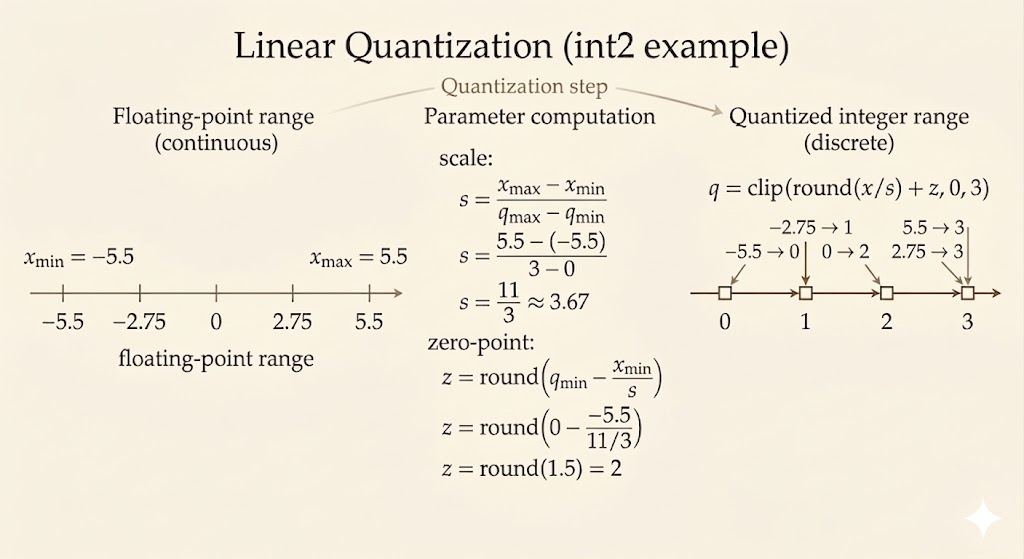
Linear quantization uses an affine map between real values and integers.
Let:
- \(r_{\min}, r_{\max}\) be the floating-point range
- \(q_{\min}, q_{\max}\) be the integer range of the target format
Then the scale is
\[ S = \frac{r_{\max}-r_{\min}}{q_{\max}-q_{\min}} \]
and the zero point is
\[ Z = \operatorname{round}\left(q_{\min} - \frac{r_{\min}}{S}\right) \]
The reconstruction formula is
\[ r \approx S(q-Z) \]
This is what lets integer values approximate real-valued weights and activations.
Compared with K-means quantization:
- linear quantization is simpler
- the hardware path is much cleaner
- integer MAC units can often use it directly
Quantized Matrix Computation
Suppose
\[ Y = WX \]
and the quantized tensors are represented by
\[ W \approx S_W(q_W - Z_W), \qquad X \approx S_X(q_X - Z_X), \qquad Y \approx S_Y(q_Y - Z_Y) \]
Then the integer kernel computes dot products of shifted integers:
\[ Y \approx S_W S_X \sum (q_W - Z_W)(q_X - Z_X) \]
After accumulation, the output is requantized:
\[ q_Y \approx \operatorname{round}\!\left( \frac{S_W S_X}{S_Y} \sum (q_W - Z_W)(q_X - Z_X) \right) + Z_Y \]
The important point is not the exact bookkeeping of every correction term. The important point is that the heavy computation happens in low-bit integer arithmetic, and only scale / zero-point corrections are handled around it.
Takeaways
- lower bit-width means lower arithmetic energy
- integer, fixed-point, and floating-point formats trade off range, precision, and hardware cost
- K-means quantization is good for compression but does not directly give low-bit compute
- linear quantization is hardware-friendly because it matches integer arithmetic
- quantized inference works by shifting integers with zero points, accumulating in integer form, and requantizing at the end