graph LR
    Root((Start)) -->|p| H1(H)
    Root -->|1-p| T1(T)

    H1 -->|p| H2_H(H)
    H1 -->|1-p| T2_H(T)

    T1 -->|p| H2_T(H)
    T1 -->|1-p| T2_T(T)

    H2_H -->|p| HHH[HHH]
    H2_H -->|1-p| HHT[HHT]

    T2_H -->|p| HTH[HTH]
    T2_H -->|1-p| HTT[HTT]

    H2_T -->|p| THH[THH]
    H2_T -->|1-p| THT[THT]

    T2_T -->|p| TTH[TTH]
    T2_T -->|1-p| TTT[TTT]
MIT 6.041 Probability: Independence
Probability
Independence
Conditional Independence
MIT 6.041
Independence as information-free probability, disjoint versus independent events, conditional independence through a hidden variable, and the difference between pairwise and mutual independence.
Independence Means Information Changes Nothing
The clean idea behind independence is:
learning that event \(A\) happened does not change the probability of event \(B\).
If \(P(A) > 0\), this is written as
\[ P(B \mid A) = P(B). \]
Using the multiplication rule, this is equivalent to
\[ P(A \cap B) = P(A)P(B). \]
So independence can be read in two ways:
- conditional view: knowing \(A\) tells us nothing about \(B\)
- product view: the probability of both is the product of the marginals
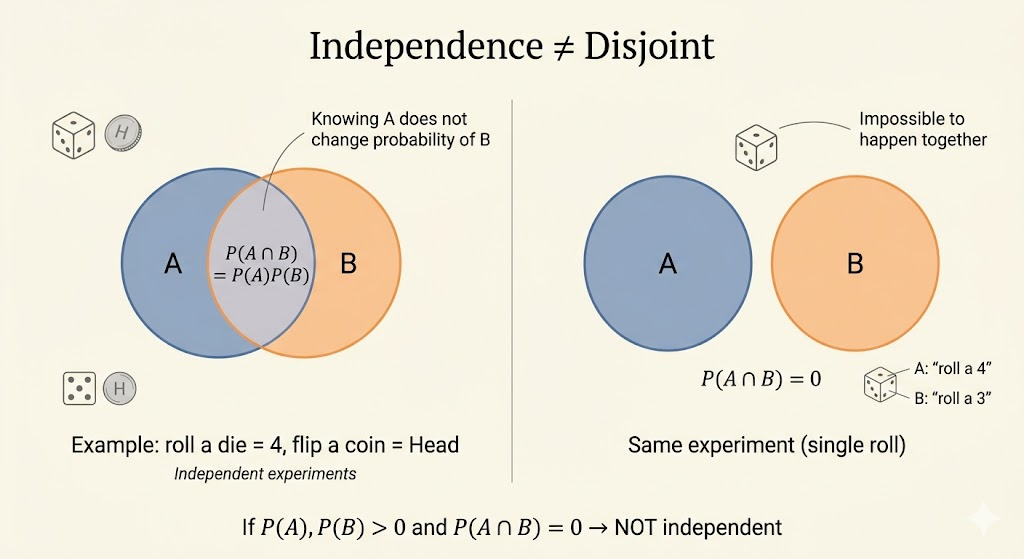
For example, if we roll a die and flip a coin, then
\[ P(\text{die}=4 \text{ and head}) = \frac16 \cdot \frac12. \]
The die outcome does not affect the coin outcome, so the events are independent.
Three Tosses of an Unfair Coin
Suppose each toss gives:
- Head with probability \(p\)
- Tail with probability \(1-p\)
The probability of a specific sequence is the product of the step probabilities. For example,
\[ P(HTH) = p(1-p)p = p^2(1-p). \]
The probability of getting exactly one head in three tosses is
\[ P(\text{exactly one head}) = 3p(1-p)^2, \]
because the one head can appear in three positions:
\[ HTT,\qquad THT,\qquad TTH. \]
Now condition on the event “exactly one head.” If the first toss is head, then the only compatible outcome is \(HTT\). Therefore
\[ P(\text{first toss is H} \mid \text{exactly one head}) = \frac{p(1-p)^2}{3p(1-p)^2} = \frac13. \]
This is a useful reminder: conditioning changes the sample space first, and only then do we compute probabilities inside the reduced world.
Independent Is Not the Same as Disjoint
These ideas are almost opposites.
- Independent means one event gives no information about the other.
- Disjoint means if one happens, the other is impossible.
So if \(P(A)>0\) and \(P(B)>0\) and the events are disjoint, then
\[ P(A \cap B)=0 \ne P(A)P(B), \]
which means they are not independent.
For instance, if \(P(A)=1/3\) and \(P(B)=1/3\) but \(A \cap B = \emptyset\), then knowing \(A\) occurred immediately tells us \(B\) did not occur. That is strong dependence, not independence.
Conditional Independence
Two events can become independent once we condition on a third event.
The definition is
\[ P(A \cap B \mid C) = P(A \mid C)P(B \mid C), \]
provided \(P(C)>0\).
This matters when there is a hidden cause behind both events.
Independence of Many Events
For events \(A_1,\dots,A_n\), independence means more than pairwise independence.
The full definition is:
\[ P\!\left(\bigcap_{i \in S} A_i\right) = \prod_{i \in S} P(A_i) \]
for every subset \(S \subseteq \{1,\dots,n\}\).
So we must check not only pairs, but also triples, quadruples, and every smaller family.
Examples of conditions that must all hold include:
- \(P(A_1 \cap A_2)=P(A_1)P(A_2)\)
- \(P(A_2 \cap A_3)=P(A_2)P(A_3)\)
- \(P(A_3 \cap A_4 \cap A_5)=P(A_3)P(A_4)P(A_5)\)
Pairwise Independent but Not Mutually Independent
Flip two fair coins with outcomes
\[ HH,\ HT,\ TH,\ TT, \]
each having probability \(1/4\).
Define events:
- \(A\) = first toss is heads
- \(B\) = second toss is heads
- \(C\) = both tosses are the same
Then
\[ P(A)=P(B)=P(C)=\frac12. \]
Also,
\[ P(A \cap B)=P(HH)=\frac14 = \frac12 \cdot \frac12, \]
\[ P(A \cap C)=P(HH)=\frac14 = \frac12 \cdot \frac12, \]
\[ P(B \cap C)=P(HH)=\frac14 = \frac12 \cdot \frac12. \]
So every pair is independent.
But for all three together,
\[ P(A \cap B \cap C)=P(HH)=\frac14, \]
while
\[ P(A)P(B)P(C)=\frac12 \cdot \frac12 \cdot \frac12 = \frac18. \]
These are not equal, so the three events are not mutually independent.
This example is important because it shows:
- pairwise independence is weaker
- mutual independence is a stronger global requirement
Interpretation
- independence means information about one event does not change probabilities of the others
- conditional independence often appears when a hidden variable explains the dependence
- pairwise independence does not guarantee mutual independence
The lecture’s core message is that independence is not just a formula. It is a statement about information flow: what we learn, and what that learning does or does not change.