Gilbert Strang’s Calculus: Six Functions, Six Rules, and Six Theorems
This lecture compresses a large part of first-year calculus into three lists: six basic functions, six differentiation rules, and six central theorems. It works as a compact map of the subject.
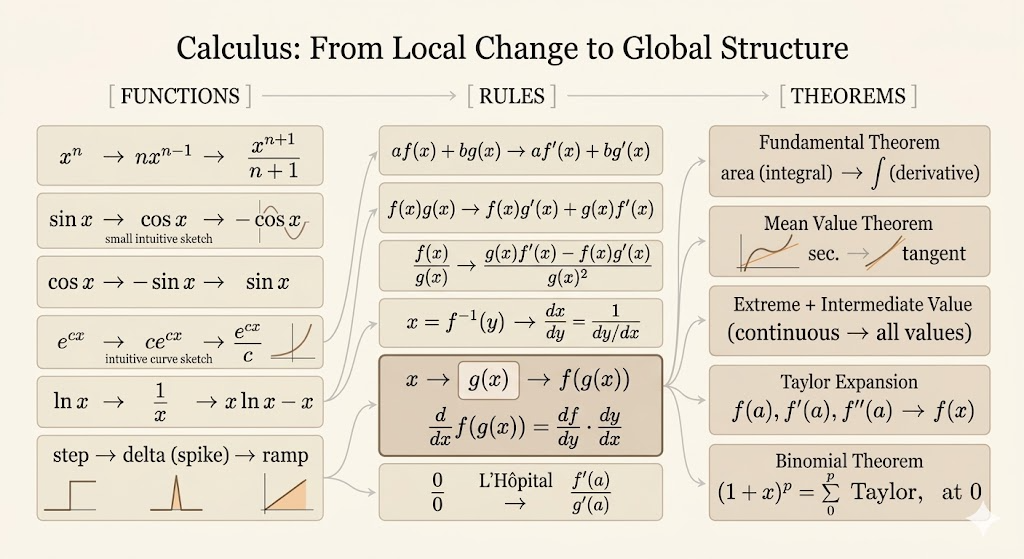
Six Functions
1. Power Function
\[ f(x) = x^n \]
- derivative: \[ \frac{d}{dx}(x^n) = n x^{n-1} \]
- integral, for \(n \ne -1\): \[ \int x^n\,dx = \frac{x^{n+1}}{n+1} + C \]
2. Sine
\[ f(x) = \sin x \]
- derivative: \[ \frac{d}{dx}(\sin x) = \cos x \]
- integral: \[ \int \sin x\,dx = -\cos x + C \]
3. Cosine
\[ f(x) = \cos x \]
- derivative: \[ \frac{d}{dx}(\cos x) = -\sin x \]
- integral: \[ \int \cos x\,dx = \sin x + C \]
4. Exponential
\[ f(x) = e^{cx} \]
- derivative: \[ \frac{d}{dx}(e^{cx}) = c e^{cx} \]
- integral: \[ \int e^{cx}\,dx = \frac{1}{c}e^{cx} + C \qquad (c \ne 0) \]
5. Logarithm
\[ f(x) = \ln x \]
- derivative: \[ \frac{d}{dx}(\ln x) = \frac{1}{x} \]
- integral: \[ \int \ln x\,dx = x\ln x - x + C \]
6. Step Function
The step function jumps from one value to another.
- derivative: a delta spike in the generalized-function sense
- integral: a ramp function
This is the only item on the list that is not an ordinary smooth function, but it is important in applications and signal processing.
Six Rules
1. Sum Rule
\[ af(x) + bg(x) \longrightarrow a f'(x) + b g'(x) \]
2. Product Rule
\[ \frac{d}{dx}[f(x)g(x)] = f(x)g'(x) + g(x)f'(x) \]
3. Quotient Rule
\[ \frac{d}{dx}\left(\frac{f(x)}{g(x)}\right) = \frac{g(x)f'(x) - f(x)g'(x)}{g(x)^2} \]
4. Inverse Rule
If \(x = f^{-1}(y)\), then
\[ \frac{dx}{dy} = \frac{1}{dy/dx} \]
provided the denominator is nonzero.
5. Chain Rule
For a composition \(f(g(x))\),
\[ \frac{d}{dx}f(g(x)) = \frac{df}{dy}\frac{dy}{dx} \]
with \(y=g(x)\).
6. L’Hopital’s Rule
For indeterminate forms such as \(0/0\) or \(\infty/\infty\),
\[ \lim_{x\to a} \frac{f(x)}{g(x)} = \lim_{x\to a} \frac{f'(x)}{g'(x)} \]
when the hypotheses of the rule are satisfied.
Six Theorems
1. Fundamental Theorem of Calculus
If
\[ f(x) = \int_a^x s(t)\,dt, \]
then
\[ f'(x) = s(x). \]
Intuition: once we know the accumulated area from \(a\) to \(x\), a tiny change \(dx\) at the right endpoint only adds a thin strip of area. That new area is approximately the current height times the width, so
\[ df \approx s(x)\,dx, \]
which explains why the rate of change of accumulated area is exactly the current height:
\[ \frac{df}{dx} = s(x). \]
The reverse direction is equally important: if \(f'(x)=s(x)\), then
\[ \int_a^b s(x)\,dx = f(b)-f(a). \]
2. Extreme Value and Intermediate Value Theorems
This is the “all values” theorem picture of continuity.
For a continuous function on a closed interval \([a,b]\):
- it reaches a maximum and a minimum
- it takes every intermediate value between them
Intuition: if you draw an unbroken curve without lifting your pen, it must hit a highest point and a lowest point, and it cannot teleport between them. So it is forced to pass through every height in between.
3. Mean Value Theorem
There exists some \(c \in (a,b)\) such that
\[ f'(c) = \frac{f(b)-f(a)}{b-a}. \]
Geometrically, at some point the tangent slope matches the average slope over the whole interval.
4. Taylor’s Theorem
A smooth function can be expanded around a point \(a\):
\[ f(x)=f(a)+f'(a)(x-a)+\frac{1}{2!}f''(a)(x-a)^2+\cdots \]
This turns local derivative information into a polynomial approximation of the curve.
5. Binomial Theorem
The binomial expansion is a special Taylor expansion of \((1+x)^p\) around \(x=0\):
\[ (1+x)^p = 1 + px + \frac{p(p-1)}{2}x^2 + \cdots \]
This works not only for positive integers, but more generally wherever the series converges.
6. Error / Remainder Idea
Taylor approximation is powerful because it comes with control of the leftover part.
In practice, we truncate after a few terms and keep a remainder term to quantify the error. That is what turns Taylor series from a formal expansion into a reliable approximation tool.
Takeaways
- the six functions give the main families whose derivatives and integrals should feel automatic
- the six rules are the basic grammar for differentiating complicated expressions
- the six theorems explain why calculus works structurally, not just computationally
- the lecture is valuable because it compresses many separate techniques into one conceptual map