MIT 6.041 Probability: Counting
This lecture turns counting into probability. Once all sample points are equally likely, probabilities become ratios of set sizes, so combinatorics becomes a direct tool for solving probabilistic questions.
Counting Principle
If the sample space \(\Omega\) is finite and all sample points are equally likely, then for any event \(A\),
\[ P(A)=\frac{|A|}{|\Omega|}. \]
This is the basic bridge from combinatorics to probability: count the favorable outcomes, count the total outcomes, and take the ratio.
Basic Counting Objects
Permutations
The number of ways to order \(n\) distinct objects is
\[ n!. \]
Subsets
A set with \(n\) elements has
\[ 2^n \]
subsets, because each element is either included or excluded.
Binomial Coefficients
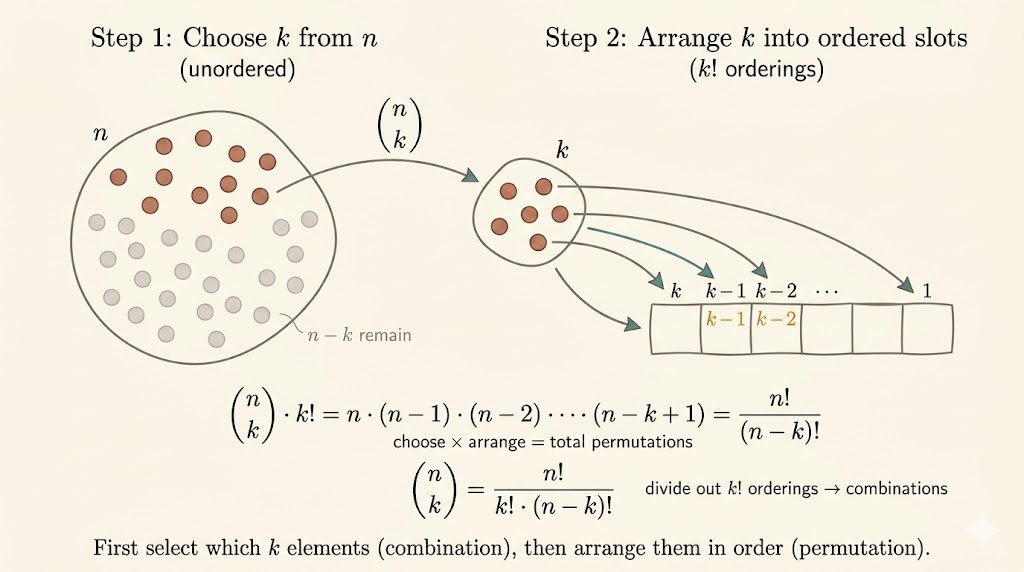
The number of ways to choose \(k\) elements from an \(n\)-element set is
\[ \binom{n}{k}. \]
Choosing and then ordering those \(k\) elements gives
\[ \binom{n}{k}k! = n(n-1)\cdots(n-k+1) = \frac{n!}{(n-k)!}. \]
So
\[ \binom{n}{k} = \frac{n!}{k!(n-k)!}. \]
Useful boundary cases:
\[ \binom{n}{n}=1, \qquad \binom{n}{0}=1. \]
And summing over all subset sizes gives
\[ \sum_{k=0}^n \binom{n}{k}=2^n. \]
This identity is just saying: if you count all subsets by size, you get the total number of subsets.
Binomial Probabilities
Suppose we toss a coin independently \(n\) times, with
\[ P(H)=p, \qquad P(T)=1-p. \]
For a particular sequence, multiply the probabilities along the sequence. For example,
\[ P(\text{HTTHHH}) = p(1-p)(1-p)ppp = p^4(1-p)^2. \]
Any sequence with exactly \(k\) heads and \(n-k\) tails has the same probability:
\[ p^k(1-p)^{n-k}. \]
There are
\[ \binom{n}{k} \]
such sequences, so
\[ P(\text{exactly }k\text{ heads}) = \binom{n}{k}p^k(1-p)^{n-k}. \]
Summing over all possible numbers of heads gives
\[ \sum_{k=0}^n \binom{n}{k}p^k(1-p)^{n-k}=1, \]
because these cases exhaust all possible outcomes. This is the binomial theorem in probability form.
Conditional Counting Example
Suppose a coin is flipped \(10\) times and we know that exactly \(3\) of the tosses were heads. What is the probability that the first two tosses were both heads?
Let
- \(B\): exactly \(3\) heads appear in \(10\) tosses
- \(A\): the first two tosses are heads
The event \(B\) contains
\[ \binom{10}{3} \]
possible placements of the three heads.
For \(A\cap B\), the first two head positions are fixed, so the remaining \(1\) head must be chosen from the last \(8\) tosses:
\[ |A\cap B|=\binom{8}{1}. \]
Therefore
\[ P(A\mid B) = \frac{P(A\cap B)}{P(B)} = \frac{\binom{8}{1}}{\binom{10}{3}}. \]
This is a nice example of conditional probability reducing to conditional counting.
Partition Example: Dealing Cards
A deck of \(52\) cards is dealt to \(4\) players, \(13\) cards each. What is the probability that each player gets exactly one ace?
Counting the Whole Sample Space
One way to count all possible deals is sequential partitioning:
\[ \binom{52}{13}\binom{39}{13}\binom{26}{13}\binom{13}{13}. \]
Counting Favorable Deals
To force each player to receive one ace:
- assign the \(4\) aces to the \(4\) players in
\[ 4! \]
ways
- then fill the remaining \(12\) cards for each player from the \(48\) non-aces:
\[ \binom{48}{12}\binom{36}{12}\binom{24}{12}\binom{12}{12}. \]
So the desired probability is
\[ \frac{ 4!\binom{48}{12}\binom{36}{12}\binom{24}{12}\binom{12}{12} }{ \binom{52}{13}\binom{39}{13}\binom{26}{13}\binom{13}{13} }. \]
The main idea is not the final expression itself, but the method: count the full partition space, count the restricted partition space, and divide.
Summary
- when sample points are equally likely, probabilities reduce to ratios of counts
- permutations count orderings, subsets count inclusion choices, and binomial coefficients count selections
- binomial coefficients connect directly to probabilities of repeated Bernoulli trials
- conditional probability problems can often be solved by conditional counting
- partition arguments are useful when outcomes are distributed across several groups